
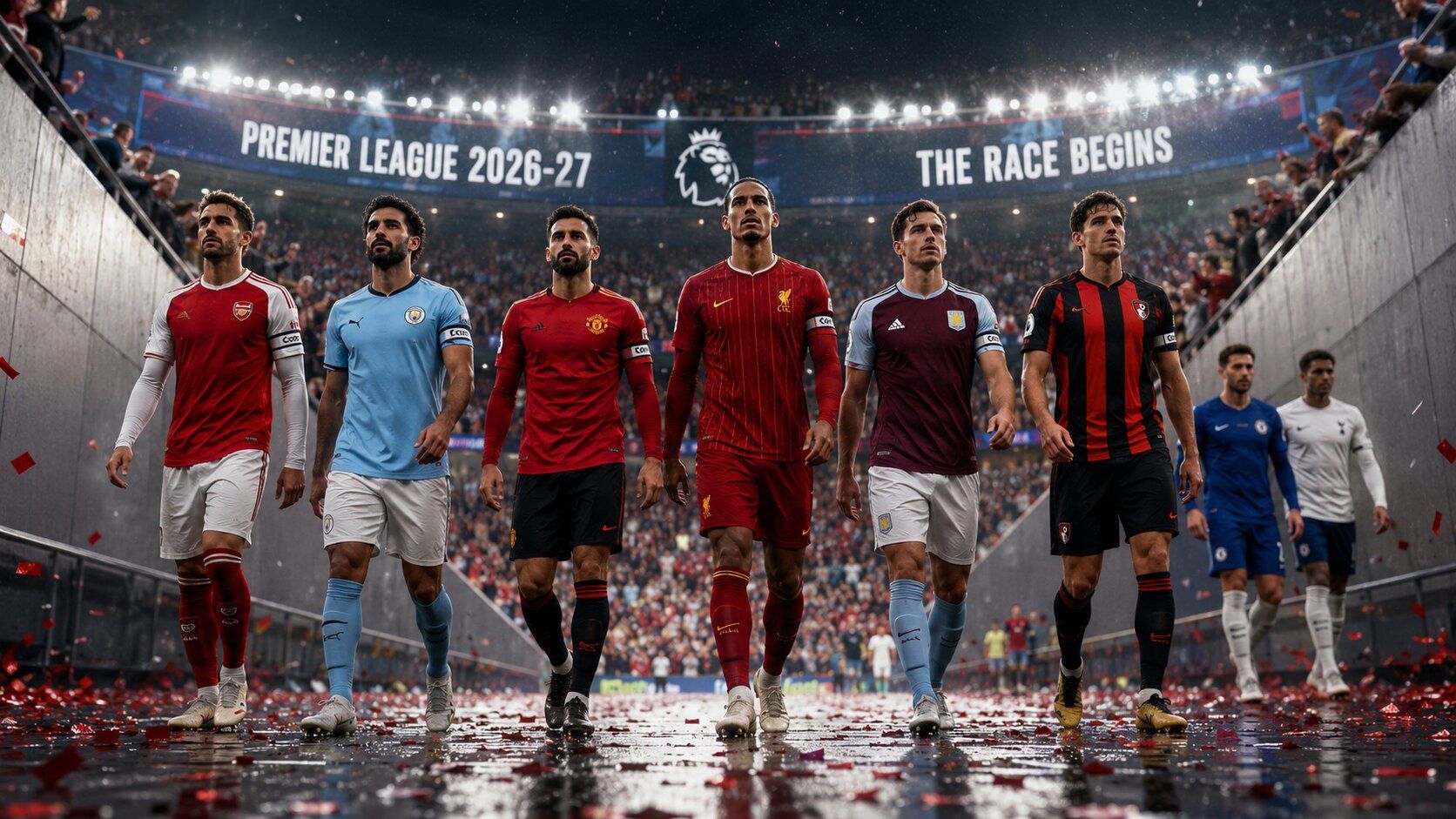
The Premier League table rarely lies, but it can still surprise.
Arsenal are champions for the first time in 22 years. AFC Bournemouth qualified for European football. Chelsea finished tenth. Tottenham Hotspur ended the campaign in seventeenth, spending the closing weeks looking over their shoulders rather than up the table.
The league's traditional "Big Six" has not simply been reshuffled. It has been redefined.
Arsenal, Manchester City, Manchester United, Aston Villa, Liverpool and Bournemouth begin the 2026-27 season carrying the burden of balancing domestic ambitions with European commitments. How each club navigates the transfer window before the Premier League returns on 22 August may prove as important as anything that happens once the football begins.
2025-26 Premier League Final Standings
| Pos | Team | P | W | D | L | GD | Pts | Europe |
|---|---|---|---|---|---|---|---|---|
| 1 | Arsenal | 38 | 26 | 7 | 5 | +44 | 85 | Champions League |
| 2 | Manchester City | 38 | 23 | 9 | 6 | +42 | 78 | Champions League |
| 3 | Manchester United | 38 | 20 | 11 | 7 | +19 | 71 | Champions League |
| 4 | Aston Villa | 38 | 19 | 8 | 11 | +7 | 65 | Champions League |
| 5 | Liverpool | 38 | 17 | 9 | 12 | +10 | 60 | Champions League* |
| 6 | AFC Bournemouth | 38 | 13 | 18 | 7 | +4 | 57 | Europa League |
*Liverpool qualified through England's additional Champions League place.
1. Arsenal: Defending the Crown
Protecting the League's Best Foundation
Mikel Arteta finally delivered the Premier League title by constructing the division's most complete defensive side.
Arsenal conceded just 27 league goals, kept 19 clean sheets and paired defensive discipline with an increasingly efficient attack. Their 85-point campaign was built less on spectacular football than relentless consistency, making them deserved champions after more than two decades of waiting.
The challenge now changes entirely.
Opponents will approach Arsenal differently. Instead of pressing aggressively or attacking openly, many will retreat into compact defensive blocks and force Arteta's side to solve increasingly difficult positional puzzles. That places greater emphasis on adding variety to an attack that still relies heavily on Martin Ødegaard's creativity and Kai Havertz's intelligent movement.
A clinical centre-forward remains the most obvious recruitment priority. Havertz has become integral to Arsenal's pressing and link-up play, but adding a striker whose primary strength is penalty-box finishing would provide another route to goals without disrupting the tactical framework that won the title.
Whatever additions arrive, Arsenal's defensive identity must remain untouched. The championship was built from defensive control, and preserving that foundation is Arteta's most important task this summer.
2. Manchester City: Beginning Again
Replacing More Than Pep Guardiola
Pep Guardiola's departure marks the biggest managerial transition English football has seen in over a decade.
His influence extended beyond tactics. Guardiola built an entire football culture around positional play, relentless technical standards and constant tactical evolution. Enzo Maresca inherits not only one of Europe's strongest squads but also the expectation of maintaining a standard few managers have ever achieved.
The departures of John Stones and Bernardo Silva remove two of City's most tactically intelligent players. Both understood Guardiola's positional system instinctively, often solving problems during matches before they reached the touchline.
Elliot Anderson's arrival strengthens midfield progression and ball carrying, but City's biggest structural requirement remains at right-back.
Maresca's possession model relies heavily on a full-back stepping into midfield during build-up phases to create numerical superiority. Without a player capable of executing that role consistently, the entire system becomes less effective.
City's pre-season schedule should offer early clues as to whether that position can be solved internally or whether another major signing is still required before the season begins.
3. Manchester United: Rebuilding the Midfield
Carrick's Biggest Problem
Michael Carrick deserves considerable credit for stabilising Manchester United after taking charge midway through last season.
Third place represented an impressive recovery, while Bruno Fernandes produced one of the finest individual campaigns of his career within Carrick's 4-3-3 system.
The optimism surrounding that progress, however, is tempered by one significant concern.
Manuel Ugarte's serious knee injury removes the defensive midfielder around whom United's midfield balance was built, while Casemiro's departure further reduces experience in the holding role.
United's reported move for Atalanta midfielder Éderson addresses an obvious need, but one signing may not be enough given the demands of both the Premier League and Champions League.
Without a reliable defensive presence behind Fernandes, United risk exposing the same transitional vulnerabilities that Carrick worked hard to eliminate during the second half of last season.
Strengthening midfield before August should remain the club's highest priority.
4. Aston Villa: Competing Within Financial Limits
Emery's Delicate Balance
Few managers extracted more from their squad last season than Unai Emery.
Champions League qualification and Europa League success represented another major step forward for Aston Villa, confirming their emergence as genuine contenders rather than occasional challengers.
Success, however, brings new complications.
Profit and Sustainability Rules alongside UEFA financial regulations mean Villa cannot simply spend their way toward greater squad depth despite qualifying for Europe's biggest competition.
Sales have created room for careful reinvestment, but Emery still requires greater depth if Villa are to compete across multiple fronts.
Midfield reinforcement and additional attacking options remain logical priorities, particularly given the expanded Champions League calendar.
Villa's recruitment strategy may ultimately depend less on expensive stars than identifying undervalued players capable of contributing immediately.
5. Liverpool: Incremental Improvement or Missed Opportunity?
Closing a 25-Point Gap
Liverpool's fifth-place finish secured Champions League football, but the table also highlighted the scale of the challenge facing Arne Slot.
A 25-point gap separated Liverpool from Arsenal.
Jeremy Jacquet's arrival adds promising defensive depth, yet it feels more like long-term planning than immediate title-building.
The gap left by Slot has been filled by Andoni Iraola. The 43-year-old Basque manager signed a two-year deal with the club ahead of the 2026–27 season, taking over after Arne Slot was sacked. Iraola arrived at Anfield following three highly impressive campaigns in the Premier League with AFC Bournemouth, culminating in a historic sixth-place finish. The club has traditionally balanced measured squad evolution with decisive investment whenever genuine quality became available and Iraola has been appointed to implement an aggressive, urgent, and front-foot style of football.
Whether further additions arrive before August may determine whether Liverpool return to the title conversation or remain on the fringes of it.
6. AFC Bournemouth: From Surprise Package to European Contenders
Sustaining the Momentum
Bournemouth's rise remains one of the stories of the 2025-26 season.
A sixth-place finish and qualification for European football reflected sustained tactical excellence rather than good fortune.
Marco Rose now faces a different challenge.
Europa League football increases both the physical and tactical demands placed upon a squad built primarily for domestic competition.
The arrival of Álvaro Rodríguez provides another attacking option alongside Evanilson and offers greater flexibility across a demanding schedule.
Integrating new signings quickly while preparing players for Thursday-Sunday football will determine whether Bournemouth establish themselves as consistent European contenders or experience the inevitable regression many first-time qualifiers encounter.
The Race Begins Before the Opening Weekend
The transfer window remains open until September, but the Premier League season starts on 22 August.
Clubs that solve their structural weaknesses before opening day will begin with momentum. Those still relying on late-window business risk spending the opening months correcting problems that were already evident during the summer.
Manchester United need midfield stability.
Manchester City require clarity at right-back.
Liverpool still need greater attacking firepower.
Aston Villa require depth within financial limits.
Bournemouth must prepare for Europe without sacrificing domestic consistency.
Arsenal simply need to ensure success does not breed complacency.
Chelsea and Tottenham should not be ignored. New managerial appointment and player transfers provide both clubs with an opportunity to recover quickly after disappointing campaigns, and history suggests established powers rarely remain outside the European conversation for long.
But for now, this is the Premier League's new hierarchy.
Whether it remains intact beyond August is the first major question of the 2026-27 season.
Published: 6 July 2026 | FootballMatrix Analytics Desk
Support The Football Matrix on Google Search
Add us as a preferred source to highlight our transfer & injury intelligence in your search results.
Discussion (0)
Loading comments...