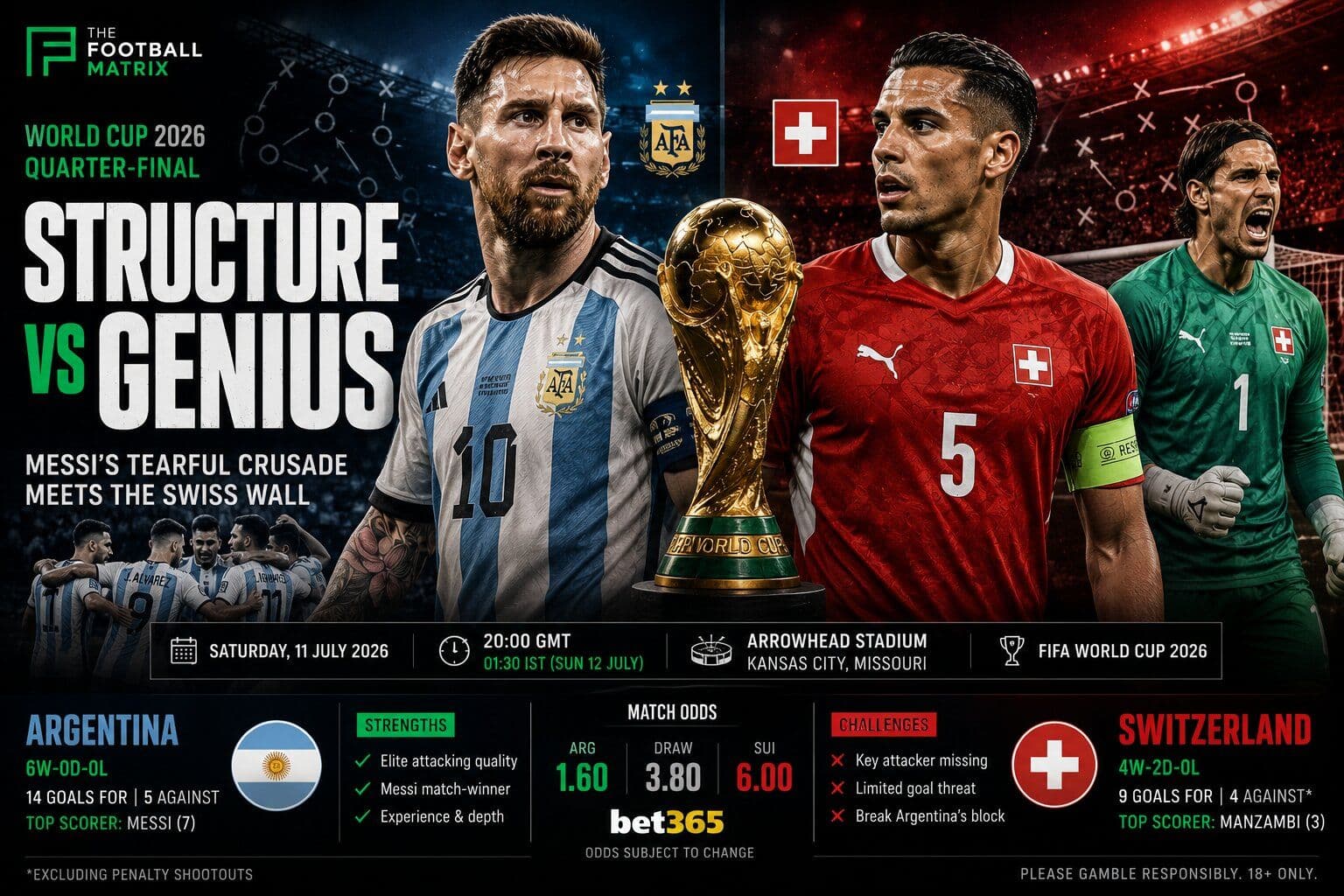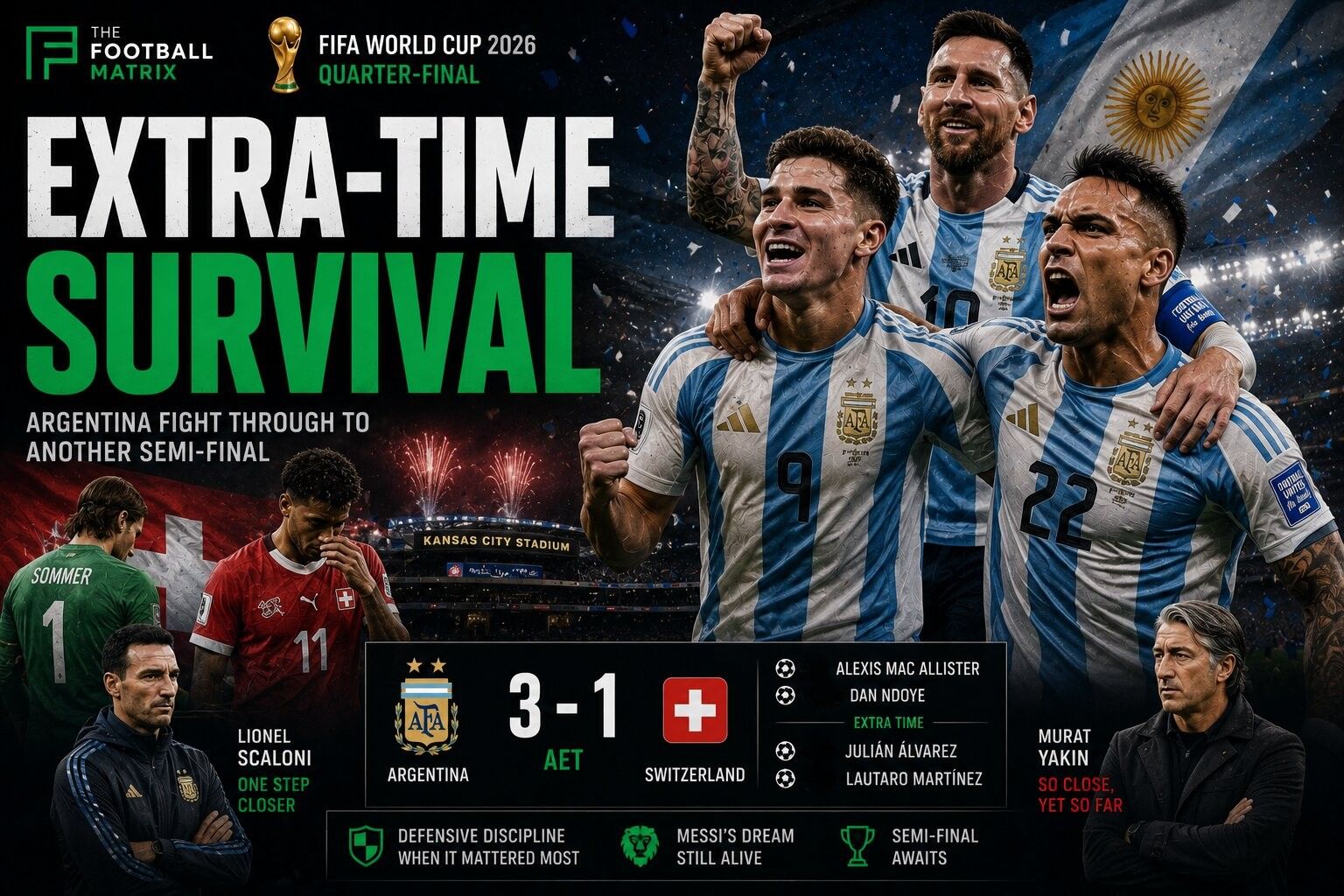
The scoreline says 3-1. The match itself was far closer to a genuine crisis for the reigning champions. Argentina needed extra time, a contentious refereeing decision and two moments of individual quality to overcome a Switzerland side that pushed them to the limit for much of the night. Kansas City witnessed history inside the opening 10 minutes and drama deep into extra time. Both are essential to understanding how Lionel Scaloni's side kept their World Cup title defence alive.
Performance Breakdown
| Match Metric | Argentina | Switzerland |
|---|---|---|
| Final Score | 3 | 1 |
| Goals Scored | Mac Allister 10', Álvarez 112', Martínez 120+1' | Ndoye 67' |
| Total Shots (On Target) | 19 (8) | 7 (3) |
| Possession | 58% | 42% |
| Disciplinary Summary | 3 yellow cards | 2 yellow cards, 1 red card (Embolo) |
1. A Slice of History: Messi's Record-Breaking Contribution
Early Control Rewards Argentina
The record arrived inside the opening 10 minutes. Lionel Messi's inswinging corner found Alexis Mac Allister unmarked at the back post, and the midfielder powered his header beyond Gregor Kobel to hand Argentina the lead. In doing so, Messi registered his 10th World Cup assist, setting a new tournament record and adding another milestone to an extraordinary international career.
Scaloni's tactical setup laid the foundation for that breakthrough. Argentina's narrow 4-1-3-2 shape crowded central areas, limiting Granit Xhaka's influence during the opening stages and forcing Switzerland away from their preferred build-up patterns. The sustained territorial pressure eventually produced the corner from which Mac Allister scored.
The challenge for Argentina was maintaining that control. As the match progressed, they gradually retreated, allowing Switzerland to dictate larger spells of possession.
2. Switzerland Fight Back
Exploiting Argentina's Left Side
Switzerland's improvement was tactical rather than emotional. Murat Yakin adjusted his side to overload Argentina's left defensive channel, repeatedly targeting the space around Nahuel Molina whenever Rodrigo De Paul advanced.
The equaliser reflected that adjustment. Ricardo Rodríguez's overlapping movement created space for Dan Ndoye, whose intelligent run and composed finish in the 67th minute brought Switzerland deservedly level. At that stage, the momentum had shifted noticeably. Argentina struggled to regain control, while Switzerland increasingly looked capable of finding a winner before extra time.
3. The Decisive Flashpoint
VAR Changes the Match
The defining refereeing moment arrived in the 72nd minute.
Leandro Paredes was initially shown a yellow card following an incident involving Breel Embolo. After a VAR review, officials concluded that Embolo had simulated contact before any foul had occurred. The original booking was rescinded and, under the tournament's disciplinary protocol, Embolo instead received his second yellow card and was sent off.
Regardless of how the decision is ultimately judged, its impact on the match was undeniable. Switzerland lost their central attacking reference point and were forced into a far more conservative defensive shape, reducing the attacking momentum they had built following Ndoye's equaliser.
4. Argentina Find the Quality
Álvarez Delivers Before Martínez Seals It
Even with a numerical advantage, Argentina struggled to break down Switzerland's disciplined defensive block. The breakthrough required a moment of genuine individual brilliance rather than sustained pressure.
In the 112th minute, Julián Álvarez collected possession outside the penalty area before curling an outstanding strike into the top corner, giving Kobel no chance. It was a finish that reflected precision rather than circumstance.
Lautaro Martínez completed the victory in stoppage time, converting after Thiago Almada led a swift counterattack. The final 3-1 scoreline ultimately overstated Argentina's superiority after more than 110 minutes of a fiercely contested quarter-final.
Looking Ahead
Argentina now travel to Atlanta for a heavyweight semi-final against England after Thomas Tuchel's side eliminated Norway in extra time.
The physical context is worth noting. Argentina required 120 demanding minutes in Kansas City's heat, while England also endured extra time in Miami. On the opposite side of the bracket, France progressed in normal time against Morocco, preserving valuable energy as the tournament enters its decisive stage.
From a tactical perspective, Switzerland also exposed areas Argentina will want to address. Their second-half transitions consistently found space around Argentina's defensive structure once Scaloni's side retreated deeper. A more clinical opponent could prove even more punishing if those issues persist.
Messi's record-breaking assist keeps his final World Cup campaign firmly in the spotlight, while the Golden Boot race remains alive as the tournament moves into its final week.
The Bottom Line
Argentina reached another World Cup semi-final through resilience as much as quality. Messi created history, Mac Allister gave the champions an early advantage, but Switzerland's tactical adjustments exposed vulnerabilities that forced Argentina into extra time before Álvarez and Martínez settled the contest.
The champions remain alive, yet this performance suggested they are no longer imposing control as consistently as earlier in the tournament. Against England, another display of this nature may not be enough. Argentina still possess the individual quality to decide the biggest matches, but Kansas City showed that their margin for error is becoming increasingly narrow.
Support The Football Matrix on Google Search
Add us as a preferred source to highlight our transfer & injury intelligence in your search results.
☕ Keep The Matrix Running
The Football Matrix is independent — no ads, no paywalls, no corporate sponsors. If our coverage adds value to your matchday, consider buying us a coffee. It goes directly toward hosting, infrastructure, and keeping the editorial free for everyone.
Discussion (0)
Loading comments...