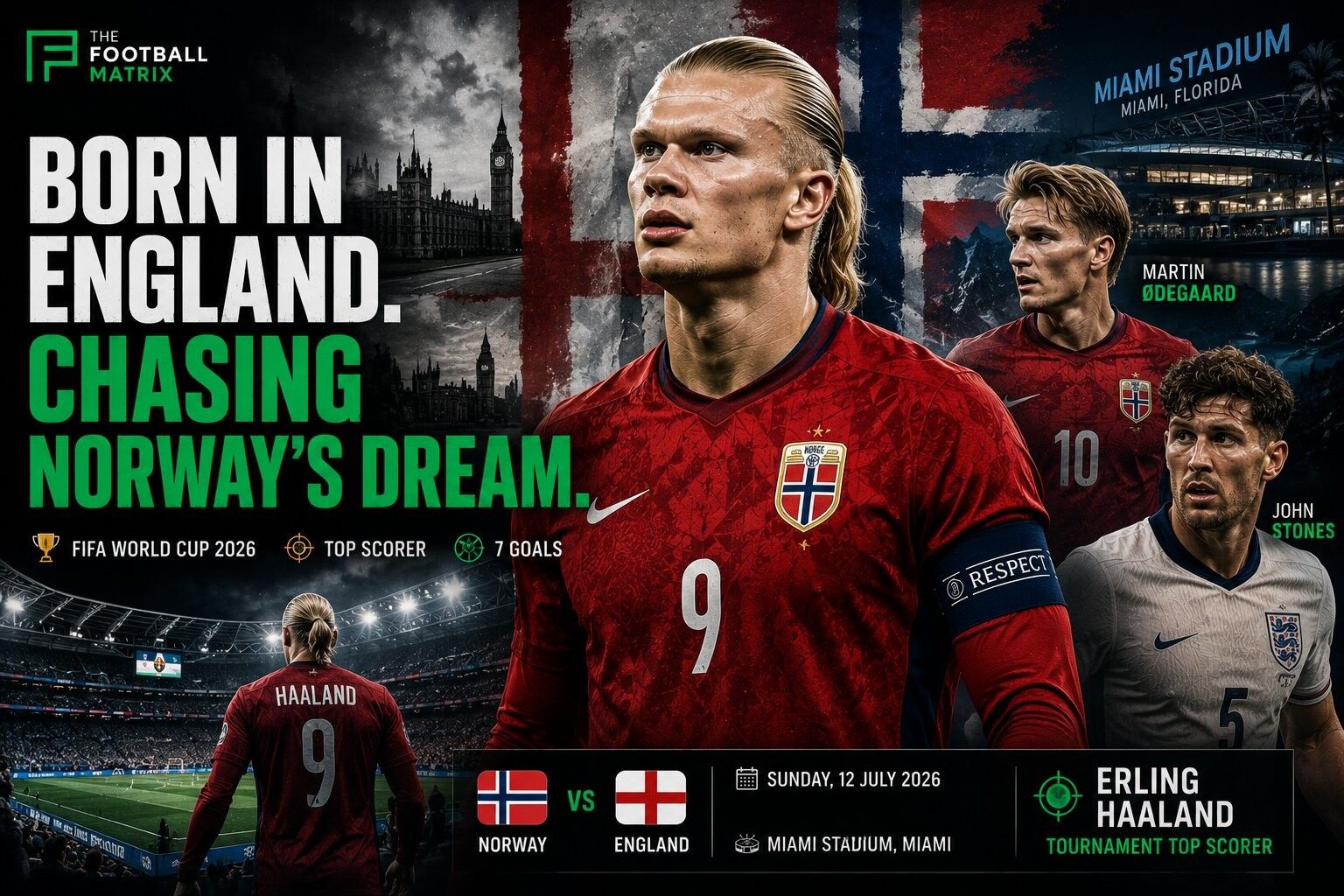
"Extra special." That was how Erling Haaland described facing England in his pre-match press conference on Friday, and the phrase carries more weight than the usual pre-match platitude. Haaland was born in Leeds. Under FIFA eligibility rules, he was once a player England could have called their own. On Saturday in Miami, he faces the country of his birth for a place in a World Cup semi-final, lining up against defenders he knows from years of Premier League football. The occasion carries an obvious emotional subplot, but the more compelling story is footballing: what happens when the tournament's most prolific striker meets a defence whose strengths and weaknesses he understands as well as anyone.
Erling Haaland: 2026 FIFA World Cup Performance Profile
| Metric | Value | Tournament Rank / Context |
|---|---|---|
| Goals Scored | 7 | 3rd (After Kylian Mbappé and Lionel Messi who are on 8 goals) |
| Appearances | 4 | Started and completed every minute for Norway |
| Goals-per-Game Ratio | 1.75 | Highest efficiency rate among active forwards |
| Shots on Target vs. Brazil | 3 | Two goals from four total shots against the Seleção |
1. The Alternate Universe: How Close England Came to the Ultimate Weapon
The Elland Road Roots and the Choice of 2019
Erling Haaland was born on July 21, 2000, in Leeds while his father, Alf-Inge Haaland, was playing for Leeds United. Alf-Inge's English career had already included spells at Nottingham Forest and would later continue at Manchester City, making Erling's birthplace the natural consequence of a family established in English football. Under FIFA's eligibility rules at the time, that birth gave Haaland the option of representing England before committing his international future elsewhere.
Alf-Inge Haaland's English Football Timeline
Alf-Inge spent more than a decade in English football across Nottingham Forest, Leeds United and Manchester City, earning 34 senior caps for Norway during that period. His son has since gone on to become Norway's all-time leading goalscorer, but the family's connection to English football remains central to the story surrounding this quarter-final.
Following Alf-Inge's retirement in 2003, the family returned to Norway, where Haaland progressed through every level of the national youth setup before making his senior debut in September 2019. There was no prolonged international tug-of-war or late change of heart. His football education took place in Norway, and representing the national team was the natural progression of that journey.
2. Domestic Mastery Turned Global Challenge
Four Seasons of Premier League Familiarity
International football often presents elite forwards with unfamiliar opponents and tactical systems. This match offers Haaland something different. After four seasons as one of the Premier League's defining strikers, he faces defenders whose habits he has studied not through video analysis alone but through years of direct competition.
That familiarity works both ways. Haaland understands the timing of England's defensive line, the recovery patterns of its centre-backs and the moments when space typically appears behind them. England, equally, know the precision of his movement and the consequences of allowing him even a fraction of separation. Rather than an encounter shaped by surprise, this is likely to become a contest of execution between players who already understand each other's tendencies.
3. Unpacking the Seven-Goal Surge: How Solbakken Creates Space for the King
The Fallout of the Brazil Masterclass
Haaland's brace against Brazil in the Round of 16 showcased efficiency as much as finishing quality. Scoring twice from four shots reflected not only clinical execution but also Norway's ability to engineer high-value opportunities against one of the tournament's strongest defensive units.
Much of that structure revolves around Martin Ødegaard. Operating between the lines, the captain provides Norway's primary creative outlet while forcing opposing midfielders to make difficult defensive decisions. Closing Ødegaard aggressively risks leaving Haaland isolated against a single defender. Dropping additional cover toward Haaland creates the passing lanes Ødegaard thrives upon.
Norway's attacking transitions are built around exploiting exactly that dilemma. Rather than overwhelming opponents with numbers, Ståle Solbakken's system aims to isolate Haaland in favourable one-versus-one situations where his combination of pace, strength and finishing becomes decisive.
England's response is likely to begin with John Stones, expected to return following Jarell Quansah's suspension. Few defenders understand Haaland's movement as well as Stones after years together at Manchester City. That familiarity offers England a tactical advantage, but it is not a guarantee. Reading Haaland's intentions is one challenge; preventing them over ninety minutes is another, particularly against a striker arriving in outstanding form.
The Weight of the What-If
English football has periodically revisited the idea of what a Leeds-born Haaland might have looked like in a Three Lions shirt. It remains an intriguing hypothetical, but ultimately no more than that. International careers are shaped as much by identity, upbringing and development as by eligibility rules, and Haaland's progression through Norway's youth system made his eventual senior commitment feel inevitable.
That thought experiment gains renewed attention this week because of the stakes. Haaland is not simply facing England; he is attempting to end their World Cup campaign, adding another chapter to a career already defined by scoring on football's biggest stages.
The Bottom Line
The emotional narrative surrounding Haaland's birthplace is difficult to ignore, but it is unlikely to decide this quarter-final. The tactical battle is far more significant. Norway have constructed a system designed to maximise the qualities of one of the world's most complete centre-forwards, while England must find a way to contain a striker who already understands the rhythms of their defensive structure better than almost anyone.
For Norway, victory would represent another extraordinary step in a historic World Cup run. For Haaland, eliminating the country he could once have represented would add another layer to an international career that continues to redefine expectations with every tournament.
Support The Football Matrix on Google Search
Add us as a preferred source to highlight our transfer & injury intelligence in your search results.
Discussion (0)
Loading comments...