The theory was that this shouldn't happen anymore. Multi-club scouting networks, continuous algorithmic tracking, and data departments monitoring youth football across four continents were supposed to remove much of the surprise from the transfer market. A player's value was expected to be established long before a major tournament, built on seasons of evidence rather than four weeks of knockout football.
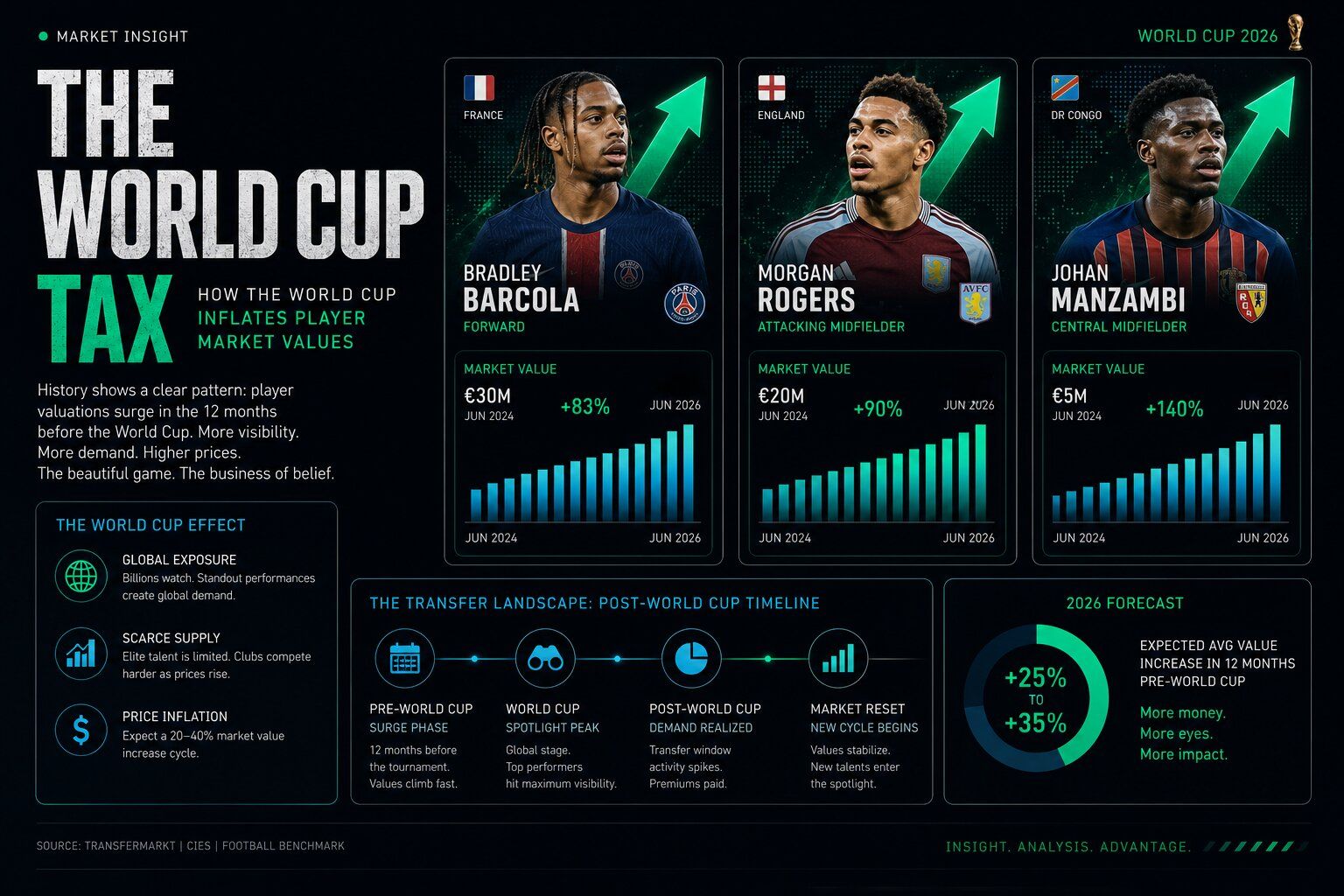
The 2026 World Cup has challenged that assumption. Premier League clubs, buoyed by broadcasting revenue but operating within Profit and Sustainability Rules, are watching the quarter-finals not only to scout emerging talent but also to see long-standing transfer targets become significantly more expensive. Call it the World Cup Tax — the premium that separates a player's valuation before the tournament from the price his club is likely to demand once it ends.
Projected Post-Tournament Premium Valuations
| Player | Current Club | Pre-Tournament Market Value | Post-Round of 16 Projected Price Tag | Primary EPL Suitors |
|---|---|---|---|---|
| Bradley Barcola | PSG | £60m | £85m–£90m | Arsenal, Chelsea |
| Gilberto Mora | Tijuana | £8m | £35m–£40m | Liverpool, Manchester City, Tottenham |
| Johan Manzambi | SC Freiburg | £12m | £45m (post-injury baseline) | Newcastle |
| Morgan Rogers | Aston Villa | £40m | £80m-£130m | Arsenal, Chelsea |
1. Bradley Barcola: Arsenal's Ultimate £90m Flank Target
A Different Profile for Arsenal's Left Side
Barcola's tournament has been defined by repeatable qualities rather than isolated moments. Across France's knockout matches, he has consistently stretched defensive lines with progressive carries, direct running and disciplined defensive work, giving Didier Deschamps a reliable outlet against compact opponents.
That profile naturally aligns with Arsenal's reported search for greater athleticism in wide areas should Leandro Trossard depart. A winger capable of attacking defenders one-on-one while also contributing defensively would ease some of the creative burden carried by Bukayo Saka and offer Mikel Arteta another route to breaking down deep defensive blocks.
Whether a transfer materialises, however, depends on more than Arsenal's interest. Barcola already occupies an important role at Paris Saint-Germain, and a fee in the £85–90 million range only becomes realistic if both clubs and the player see sufficient value in a move.
2. Gilberto Mora: The 17-Year-Old Wonderkid Triggering an Anfield Race
Projection Versus Immediate Production
Few players have enhanced their reputation more than Gilberto Mora. At just 17 years old, he has produced composed performances on football's biggest stage, demonstrating maturity in possession and the ability to progress attacks under pressure.
That has reportedly attracted interest from several Premier League clubs, including Liverpool, Manchester City and Tottenham. His technical profile fits the type of long-term investment many elite clubs now favour: a player with considerable developmental upside rather than a finished product.
The challenge is separating genuine long-term quality from tournament-driven inflation. A valuation rising from roughly £8 million to £35–40 million in a matter of weeks inevitably reflects World Cup exposure as much as an established body of club-level evidence.
The physical adaptation also remains an important consideration. The demands of Premier League football differ significantly from Liga MX, making any investment in Mora as much about future projection as immediate impact.
3. Johan Manzambi: The Injury That Hasn't Softened the Market
Freiburg's Long-Term View
Manzambi's World Cup ended in unfortunate circumstances. Three goals and two assists established him as Switzerland's primary attacking threat before a serious knee injury ruled him out ahead of the quarter-finals.
Ordinarily, such an injury would reduce a player's market value. Freiburg appear reluctant to follow that logic. Reports suggest the club continue to value Manzambi at around £45 million, judging him on his long-term potential rather than his short-term availability.
That approach reflects confidence in his development rather than his immediate fitness. Interested clubs now face a familiar dilemma: invest before he returns, accepting the rehabilitation risk, or wait until he has recovered and potentially face even stronger competition if he rediscovers his previous level.
4. Morgan Rogers: Why Homegrown Talent Commands Its Own Premium
Scarcity Drives the Price
Morgan Rogers represents a different type of transfer inflation. His value is shaped not only by his World Cup performances but also by the structural importance of homegrown players within Premier League squad-building regulations.
Elite English talent has long carried a premium, and another strong international tournament has only strengthened Aston Villa's negotiating position. Reports linking Arsenal with Rogers therefore reflect more than a search for attacking quality; they also reflect the strategic value attached to recruiting high-level homegrown players.
From Villa's perspective, there is little incentive to lower their demands. Players capable of satisfying both sporting and registration requirements remain among the most valuable assets in the domestic market.
The Case for Caution
Tournament performances can undoubtedly reveal genuine quality, but they can also distort valuations. Football's transfer history contains numerous examples of players whose World Cup stock rose dramatically before clubs paid prices that later proved difficult to justify.
That broader context matters. A month of elite performances remains a relatively small sample compared to several seasons of club football.
Financial realities also limit how aggressively Premier League clubs can respond. Profit and Sustainability Rules mean that even Europe's wealthiest sides often need significant player sales before committing to deals worth £75–90 million. Reported valuations are therefore only one part of the equation; completing those transfers frequently depends on creating financial room elsewhere.
The Bottom Line
The World Cup Tax is real because visibility changes negotiations. Strong tournament performances strengthen a selling club's position, increase competition among buyers and elevate expectations around a player's future ceiling.
The clubs that navigate this market most effectively are unlikely to be those willing to pay every premium immediately. Instead, success will come from identifying which performances confirm an existing trajectory and which simply reflect a brief surge under football's brightest spotlight. With the Premier League season approaching, striking that balance may prove just as important as identifying the right player in the first place.
Support The Football Matrix on Google Search
Add us as a preferred source to highlight our transfer & injury intelligence in your search results.
Discussion (0)
Loading comments...