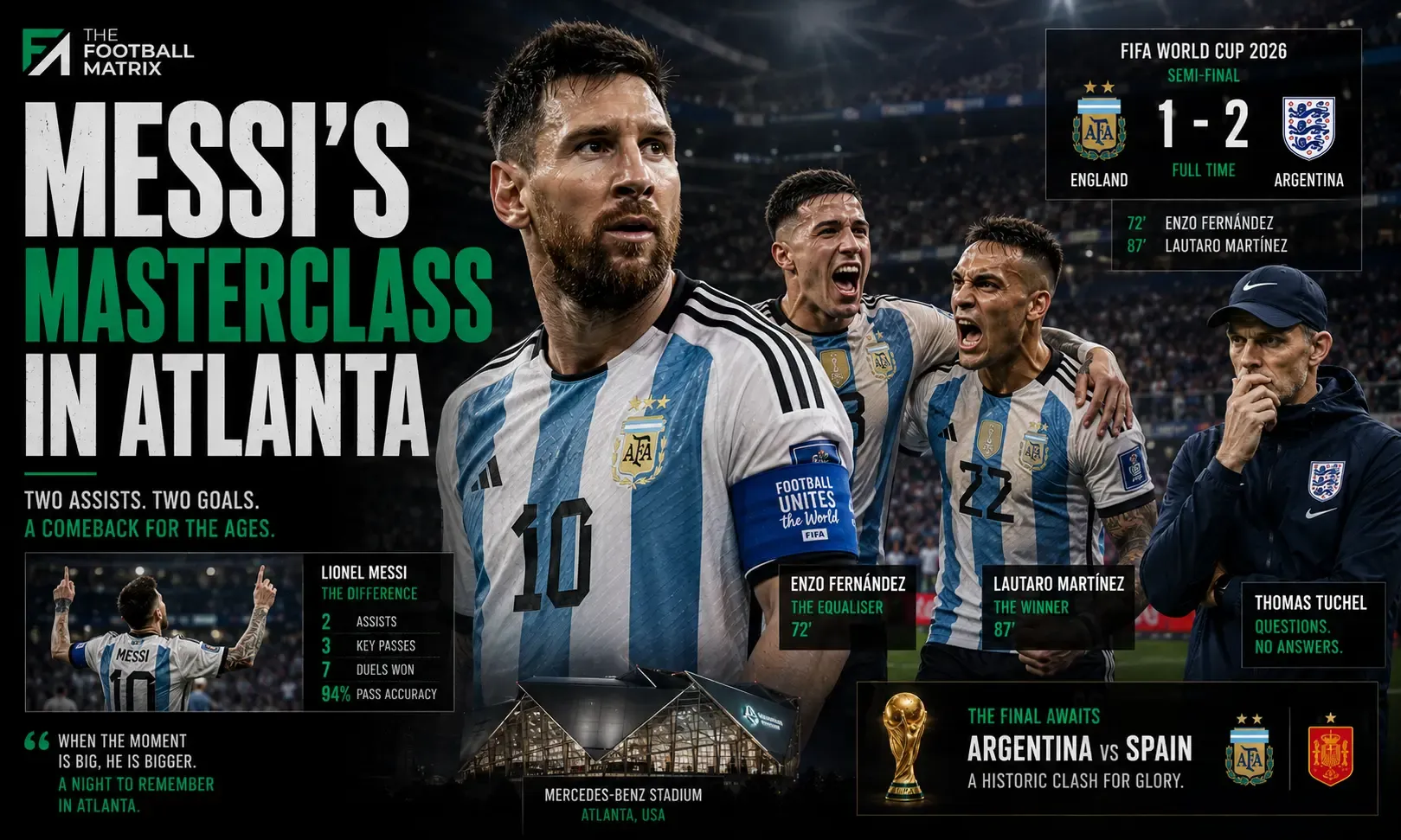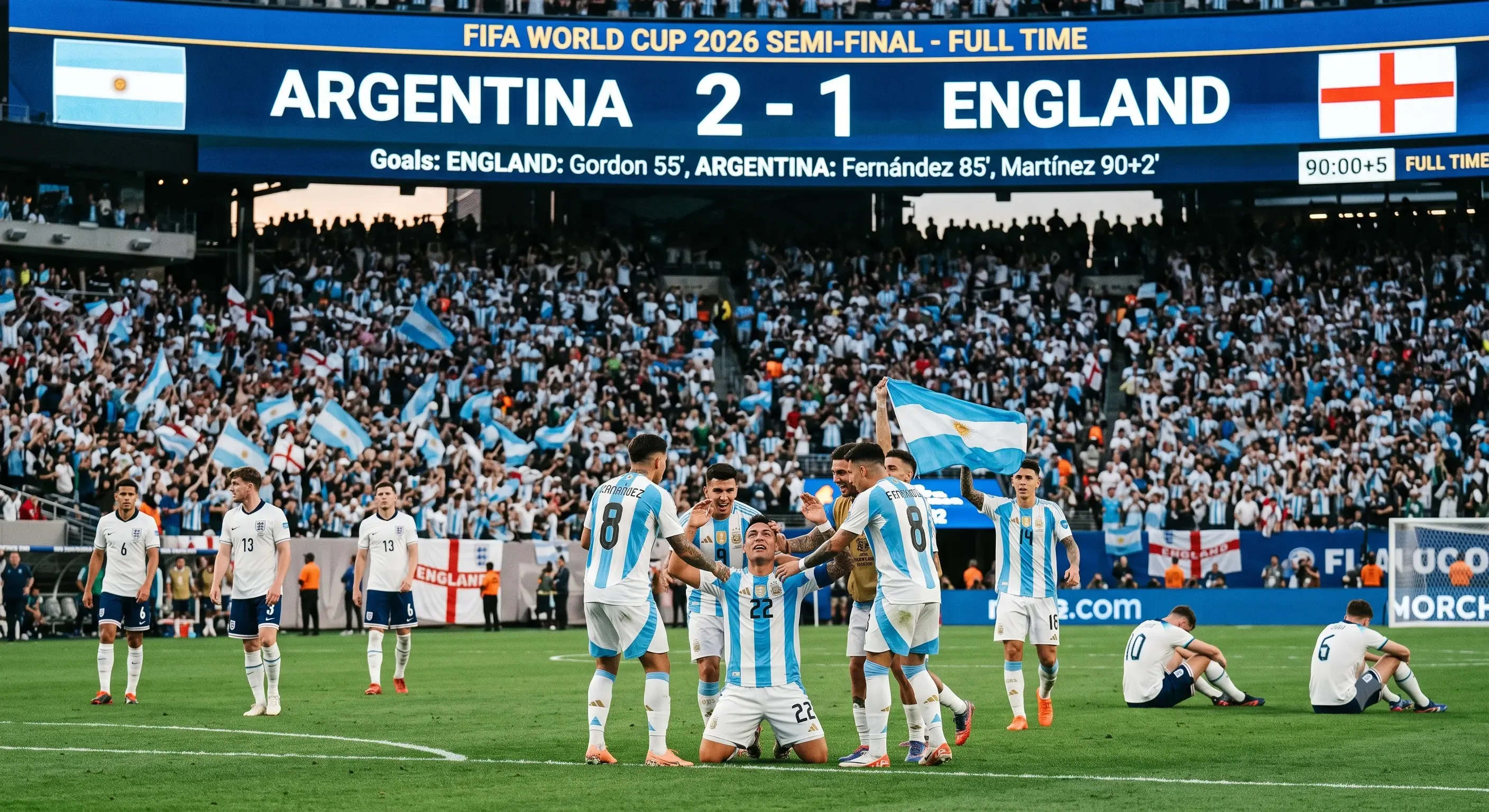
Five minutes. That's how close England came to their first World Cup final on foreign soil. Just five minutes stood between Thomas Tuchel's side and history before Lionel Messi decided otherwise.
At a sold-out Mercedes-Benz Stadium in Atlanta, 68,239 fans watched England surrender a lead they had defended with real conviction for most of the match, only to concede twice in the final ten minutes as Argentina did what they have done all tournament: strike when the clock says it's too late to strike. Enzo Fernández's 85th-minute equalizer and Lautaro Martínez's 92nd-minute header sent Lionel Scaloni's side through to a "Champions vs. Champions" final against Spain and left England facing an uncomfortable question about the moment their manager blinked.
This wasn't merely a story of Argentina being better; for long spells, they weren't. It's a narrative about what happens when you invite the best closer in the sport's history to finish the game on his terms.
1. The 76th-Minute Mistake: Analyzing Tuchel's Back-Five Gamble
Until the 76th minute, Tuchel's game plan was effective. England's 4-2-3-1 formation had kept Argentina's midfield diamond largely quiet, and the numbers bear it out: through the first 75 minutes, England held 48% possession and generated five shots, two on target. Anthony Gordon's goal, a back-post finish from Morgan Rogers' cross in the 55th minute, was the product of a team playing with real structure, not damage limitation.
Then Tuchel made the substitution that will define his tournament. Gordon, England's most dangerous transition threat, was withdrawn for central defender Ezri Konsa, shifting the shape from 4-2-3-1 to a 5-4-1 low block. The intention was clear: protect the lead, deny Argentina space, and see out the game. The execution was catastrophic.
Subbing Off the Outlet: How Removing Anthony Gordon Silenced England's Attack
Gordon's value extended beyond his goal. His willingness to run the channels forced Argentina's back line into difficult decisions. Without him, Harry Kane was left isolated near the halfway line, with no outlet to relieve pressure whenever England regained possession. The statistics from that final quarter-hour are stark: zero shots, zero touches in the opposition box, and just 18% possession. By removing their only credible counter-attacking threat, Tuchel effectively told Cristian Romero and Lisandro Martínez they could push into midfield without fear of being punished in behind. Argentina's center-backs became auxiliary midfielders, and England had no way to make them pay for it.
Surrendering Zone 14: How the Deep Defensive Block Gifted Argentina the Edge of the Box
The more damaging consequence was structural. England's midfield line dropped so deep that it sat almost on top of the back five, conceding what coaches call Zone 14—the space just outside the penalty area that's typically the most dangerous real estate on the pitch. Enzo Fernández and Alexis Mac Allister were given total freedom to collect second balls there and dictate the tempo of Argentina's approach play. It was from exactly that zone that Enzo struck his equalizer, a 20-yard effort that Jordan Pickford had no real chance against. Tuchel's block hadn't just retreated; it had left the exact area Argentina needed most completely unguarded.
2. Messi's Atlanta Masterclass: Unlocking the Three Lions for the First Time
There's a strange footnote buried in this result: across 22 years and hundreds of appearances for club and country, this was the first time Lionel Messi had ever played against England. He picked an odd time to make his debut against them.
With two assists, Messi's career World Cup goal involvements now stand at 26, extending a record that already looked untouchable. But the number matters less than the manner. Faced with a congested England block for most of the night, Messi didn't force the issue early. He drifted into a right-half-space role, dropping deeper than usual, patient in a way that suggested he understood exactly how this game would be won.
The Short-Corner Chess Move: Setting Up Enzo's Equalizing Rocket
The first goal began with a detail most viewers may have missed. Messi recognized England's zonal marking setup on corners and, instead of swinging the ball into the box, played a short pass to Enzo Fernández. The move dragged Declan Rice out of the penalty area to close him down, opening the exact pocket of space Enzo needed to take a touch, cut inside, and shoot. It wasn't a moment of individual brilliance from Messi in the conventional sense; it was spatial manipulation, the kind of subtle decision-making that rarely makes highlight reels but wins semi-finals.
Recycler-in-Chief: The Pinpoint Back-Post Cross to Lautaro Martínez
The winner was simpler in design but no less telling in its execution. As the ball came back off the crossbar and England's defenders scrambled to reset, Messi remained at the top-right corner of the box, untracked by a retreating midfield that had nothing left to give. He took a touch, assessed his options, and delivered a cross to the back post for Lautaro Martínez to head home. Two goals, two assists, and in both cases, the common thread wasn't pace or dribbling; it was Messi finding the one calm second in a chaotic moment and using it better than anyone else on the pitch could.
3. Argentina's "Cardiac Kids": The Late-Game DNA of the Defending Champions
This wasn't the first time Argentina has done this at this tournament, and that's precisely what should worry Spain heading into Sunday. Scaloni's side has now scored 10 goals after the 75th minute across the 2026 World Cup, with late turnarounds against Egypt in the Round of 16 and Switzerland in the quarter-finals preceding this latest escape act against England. That's not a fluke pattern; it's a team built, physically and mentally, to win matches in the final quarter-hour when opponents are running on fumes.
Ten After Seventy-Five: Breaking Down Argentina's Pattern of Late-Game Heroics
The consistency of this trend suggests something deliberate in how Scaloni has conditioned this squad. Whether it's superior fitness levels, tactical patience, or simply a squad conditioned to believe games aren't over until the referee says so, the outcome has been the same three times now: opponents holding a lead deep into the second half, only to watch Argentina find another gear when logic suggests they should be tiring.
Scaloni's Super-Subs: The Impact of Lautaro Martínez and Midfield Overloads
Scaloni's in-game management deserves credit too. Introducing Lautaro Martínez's physical presence for a tiring Julián Álvarez gave Argentina a different kind of threat in the box, while pushing Nahuel Molina and Marcos Acuña high up the pitch created persistent numerical overloads that John Stones and Marc Guéhi struggled to withstand once England's own outlets had been removed. It's worth noting, too, that Argentina were far from dominant for long spells. They didn't register a shot on target in the first half and leaned on set-pieces and long-range strikes to break the deadlock. This was a team that found its moment rather than controlled the match throughout.
4. The Path to MetLife: A Historic "Champions vs. Champions" Final
None of this excuses Tuchel entirely, but it's worth acknowledging the counterpoint. Before Enzo's equalizer, his defensive setup had largely worked. Pickford made three outstanding saves across the match, and Djed Spence produced a genuinely world-class tackle to deny Álvarez in the 57th minute. Shifting shape to protect a one-goal lead against the reigning champions is, in isolation, standard elite tournament management. It failed because Messi produced two moments of the highest quality, not necessarily because the concept itself was flawed. Football at this level often comes down to fine margins, and Argentina found theirs.
There is less debate about what comes next. Scaloni's players avoided yellow-card suspensions, meaning he has his full squad available for Sunday. There is uncertainty over Alexis Mac Allister, who took a heavy knock in the 81st minute and will be monitored closely in the coming days, but he did finish the match. Messi himself confirmed to broadcasters post-match that this will be his final appearance for Argentina, adding a layer of finality to what was already shaping up as one of the great international farewells.
Euro Winners vs. World Champions: Spain's Flawless Defense Meets Argentina's Late Onslaught
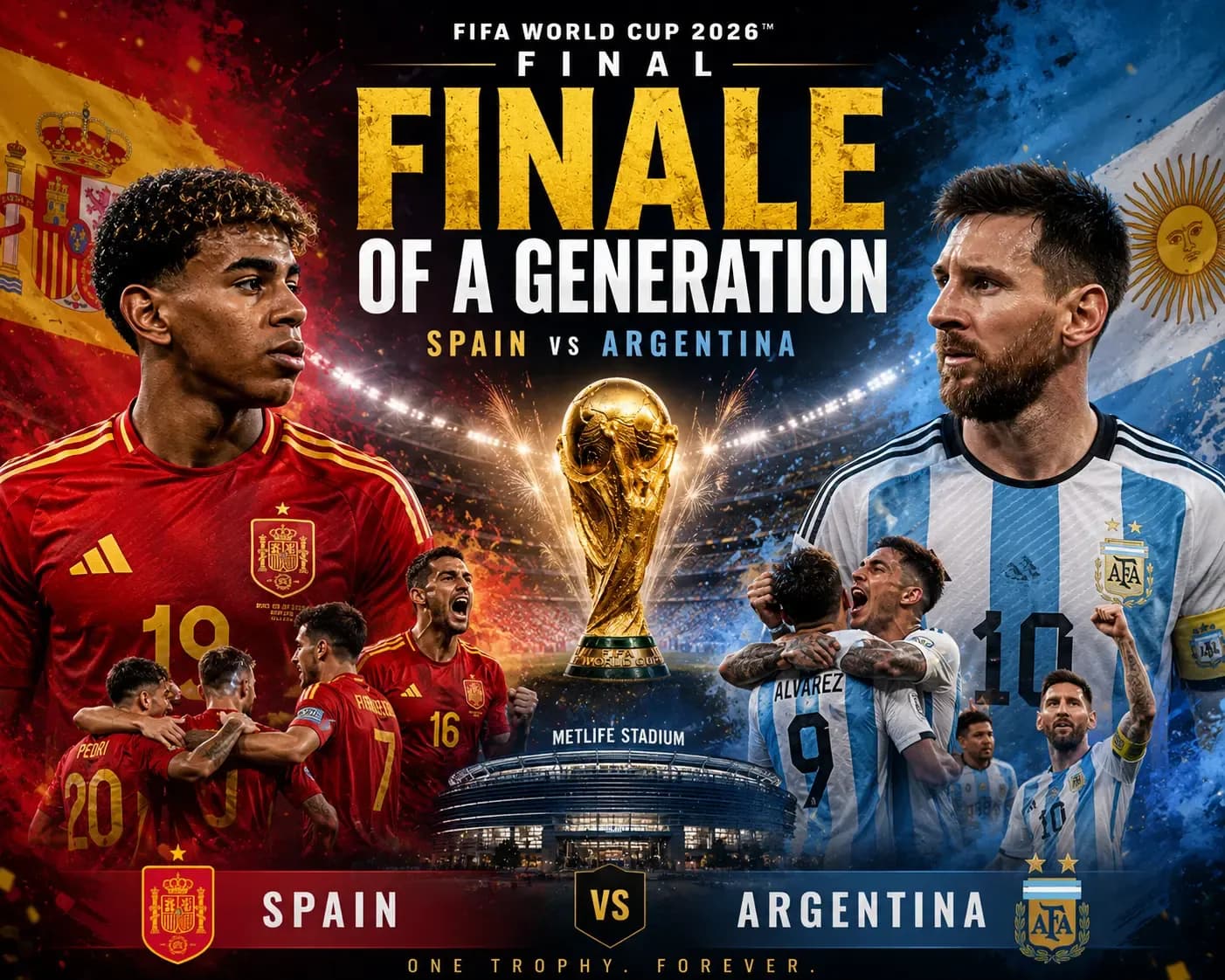
Spain arrive at MetLife Stadium having conceded just one goal in seven matches, with six clean sheets to their name after a composed 2-0 win over France, courtesy of Mikel Oyarzabal and Pedro Porro. That defensive record represents the sternest test Argentina's late-game surges will have faced all tournament. Spain don't tend to concede space in the way England did, and their possession-heavy approach limits the kind of second-phase chaos that Messi has repeatedly exploited. Whether Argentina's habit of finding a way late in games can break down a defense this disciplined is arguably the single most interesting tactical question of the entire tournament.
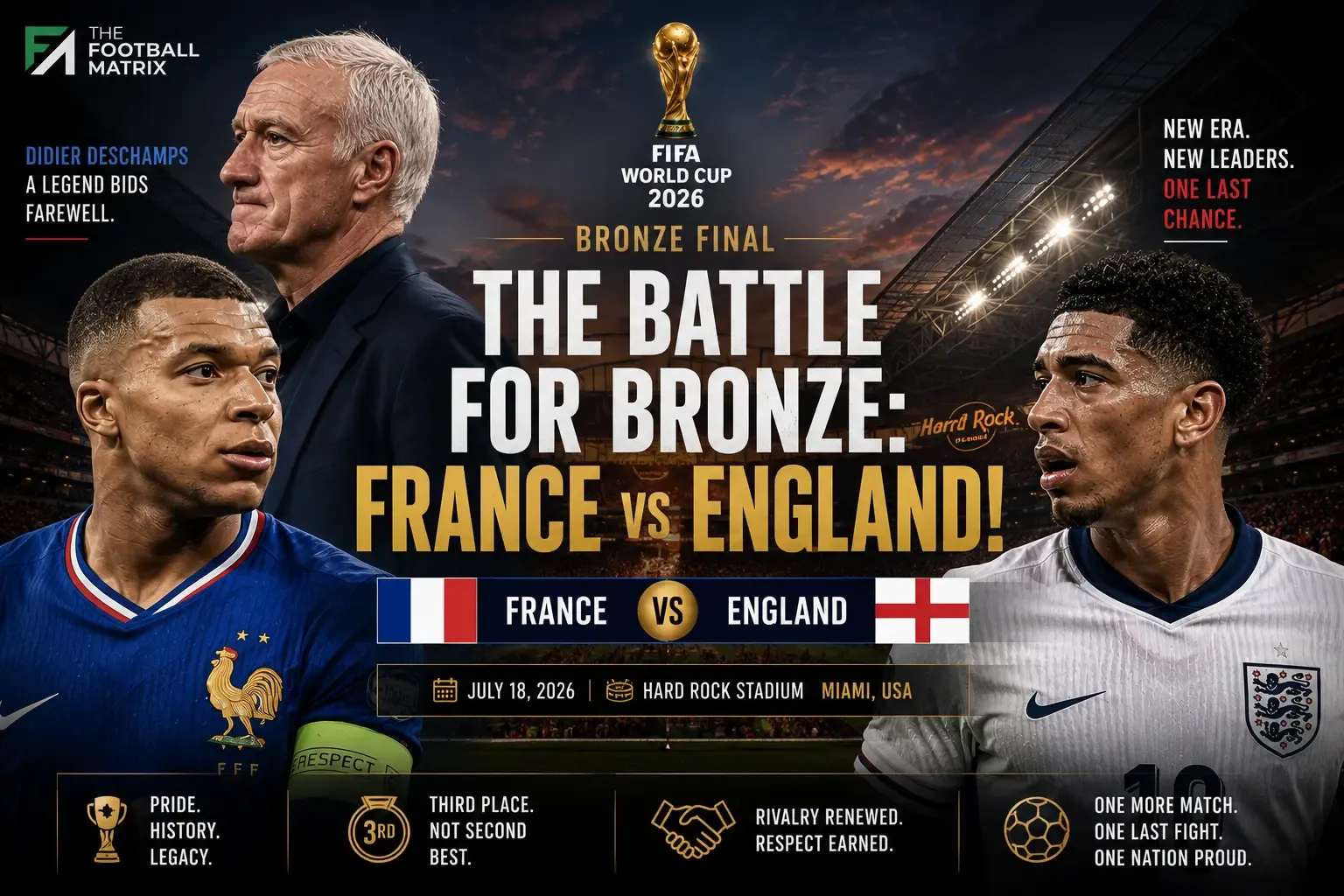
For England, there's now a different kind of business to attend to. Jude Bellingham and Harry Kane are expected to start Saturday's third-place playoff against France in Miami, despite having played heavy minutes across successive knockout rounds. It's a fixture nobody particularly wants to play, but one that still carries a World Cup medal.
Sunday belongs to something bigger. Messi's last match for Argentina, against a Spain side that has barely put a foot wrong all summer, at a stadium built for exactly this kind of occasion. Whatever happens at MetLife, football has already been given a fitting stage for how this story should end.
Support The Football Matrix on Google Search
Add us as a preferred source to highlight our transfer & injury intelligence in your search results.
☕ Keep The Matrix Running
The Football Matrix is independent — no ads, no paywalls, no corporate sponsors. If our coverage adds value to your matchday, consider buying us a coffee. It goes directly toward hosting, infrastructure, and keeping the editorial free for everyone.
Discussion (0)
Loading comments...