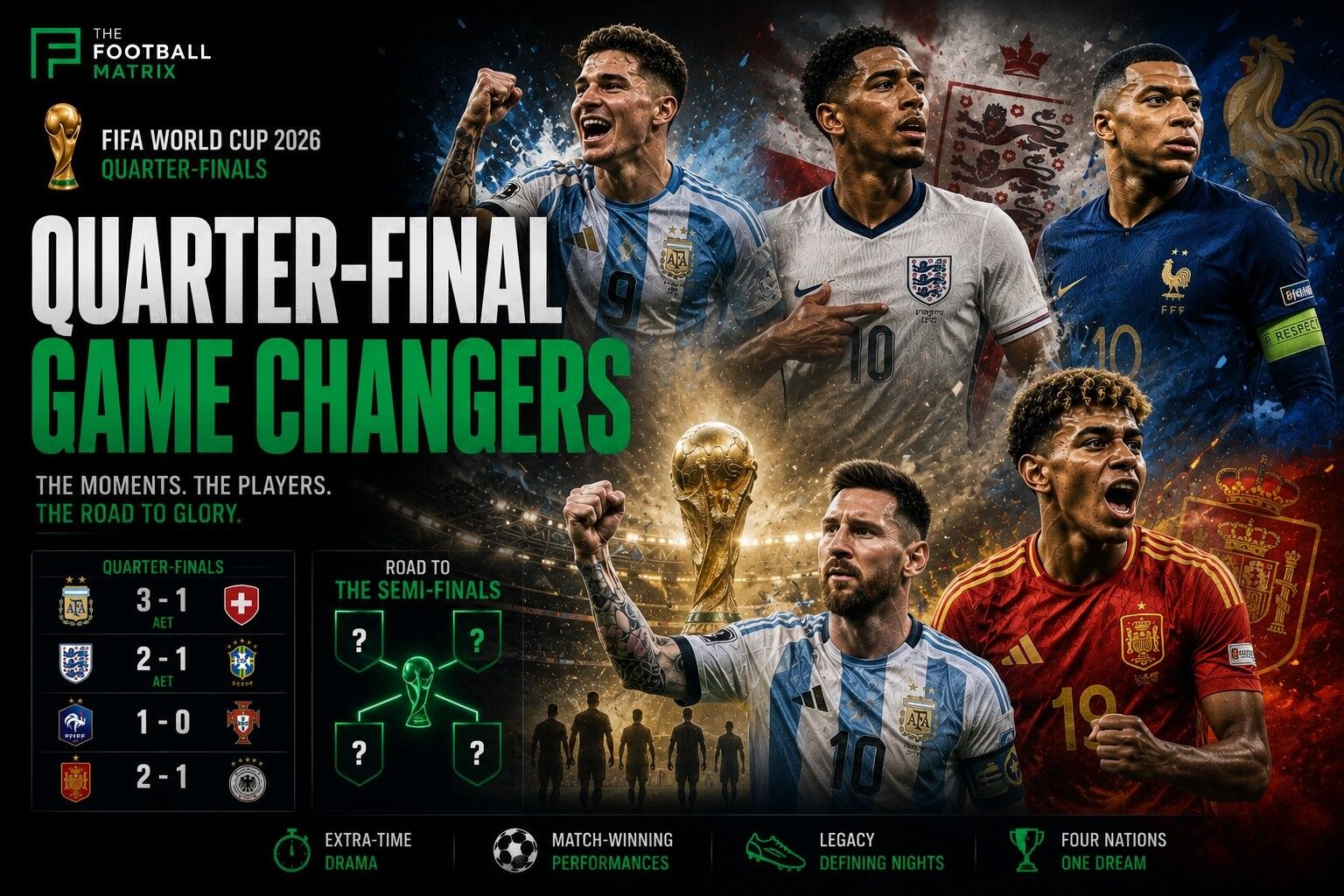
Quarter-finals are rarely won by perfect tactical plans. They are won by players who produce decisive moments when systems begin to fray. Across four physically demanding matches played in North America's summer heat, defensive structures eventually bent under fatigue, but it was individual quality that ultimately separated the semi-finalists from the eliminated.
Here are the five performances that defined the World Cup quarter-finals.
Tournament Metric Dashboard: The Quarter-Final Top Performers
| Player (Nation) | Defining Moment | Match Impact | Tournament Benchmark |
|---|---|---|---|
| Jude Bellingham (England) | 45+2', 93' | Two goals from England's six shots on target | Six tournament goals |
| Julián Álvarez (Argentina) | 112' | Extra-time winner vs. Switzerland | First tournament goal; Player of the Match |
| Lionel Messi (Argentina) | 10' | Assisted opening goal | 10 career World Cup assists |
| Mikel Merino (Spain) | Late winner | Decisive goal vs. Belgium | Continued Spain's knockout momentum |
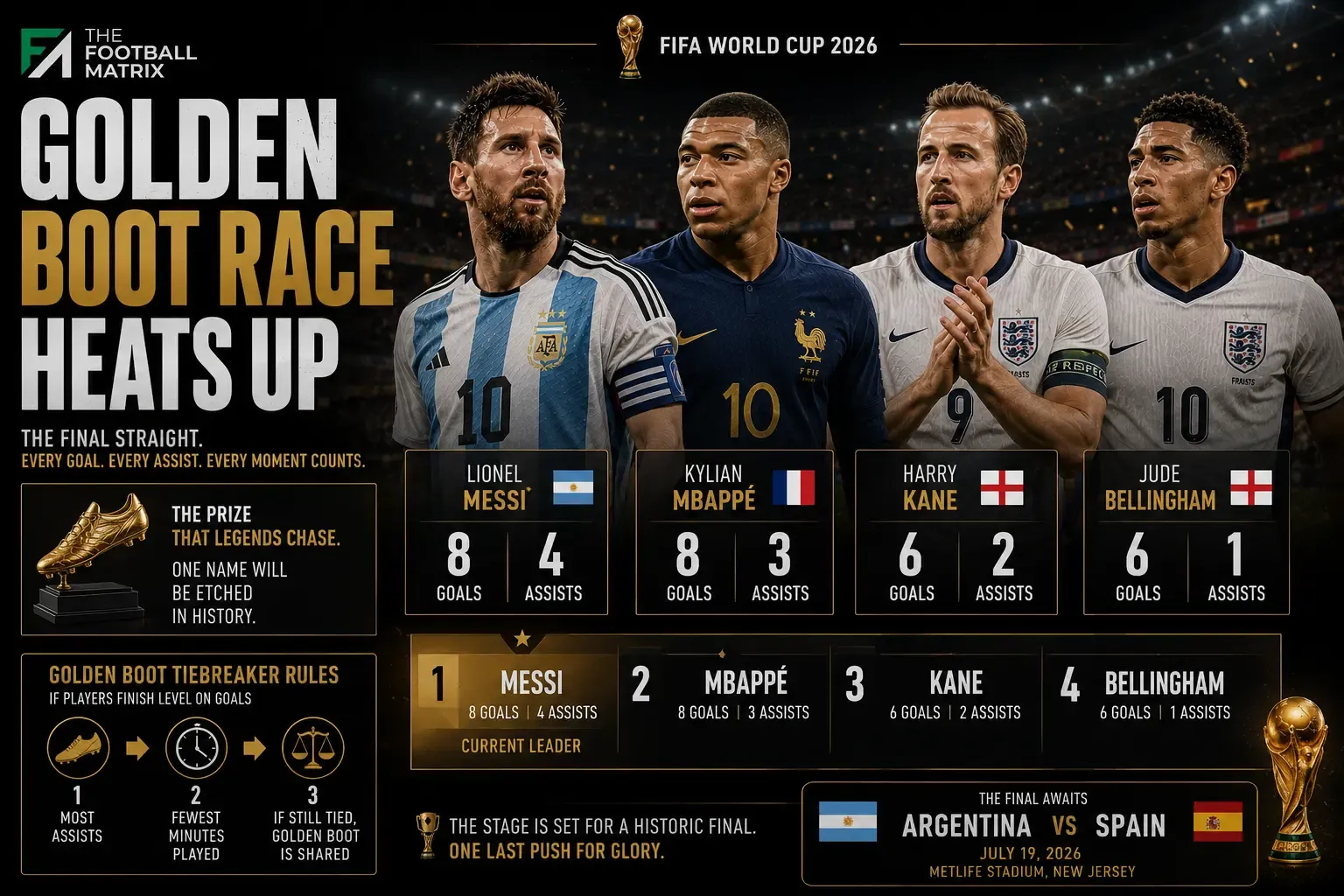
| Kylian Mbappé (France) | 60' | Broke deadlock after missed penalty | Eight goals, tournament leading scorer |
1. Jude Bellingham: England's Match-Winner in Miami
Carrying England Through Adversity
No player carried a greater individual burden during the quarter-finals than Jude Bellingham.
England entered their meeting with Norway managing injuries and suspension across the spine of the team, forcing Thomas Tuchel into significant defensive adjustments. Norway exploited those disruptions for long spells and deservedly took the lead, leaving England facing elimination.
Bellingham changed the trajectory of the match almost single-handedly.
His stoppage-time equaliser before the interval restored England's belief at a critical moment, while his extra-time winner demonstrated the anticipation that has become a defining feature of his tournament. Reacting quickest inside the six-yard box, he converted the rebound that ultimately secured England's place in the semi-finals.
The wider context elevates the performance further. England created relatively few clear opportunities, making Bellingham directly responsible for both goals in a match that demanded individual intervention rather than collective dominance.
2. Julián Álvarez: Breaking Switzerland's Resistance
Delivering When Structure Wasn't Enough
Argentina dominated possession against Switzerland but struggled to translate territorial control into clear chances.
Even after Switzerland were reduced to ten men, their compact defensive block remained difficult to break down. Argentina circulated the ball patiently but increasingly looked short of solutions as extra time progressed.
Álvarez provided one.
Receiving possession outside the penalty area in the 112th minute, he curled a superb finish beyond Gregor Kobel to finally separate the sides. It was the type of strike that cannot easily be coached or systemised—an individual moment of conviction delivered precisely when Argentina required it.
His first goal of the tournament earned Player of the Match honours and kept Argentina's title defence alive.
3. Lionel Messi: Quiet History in Kansas City
Another Record for an Extraordinary Career
Messi's influence arrived long before extra time.
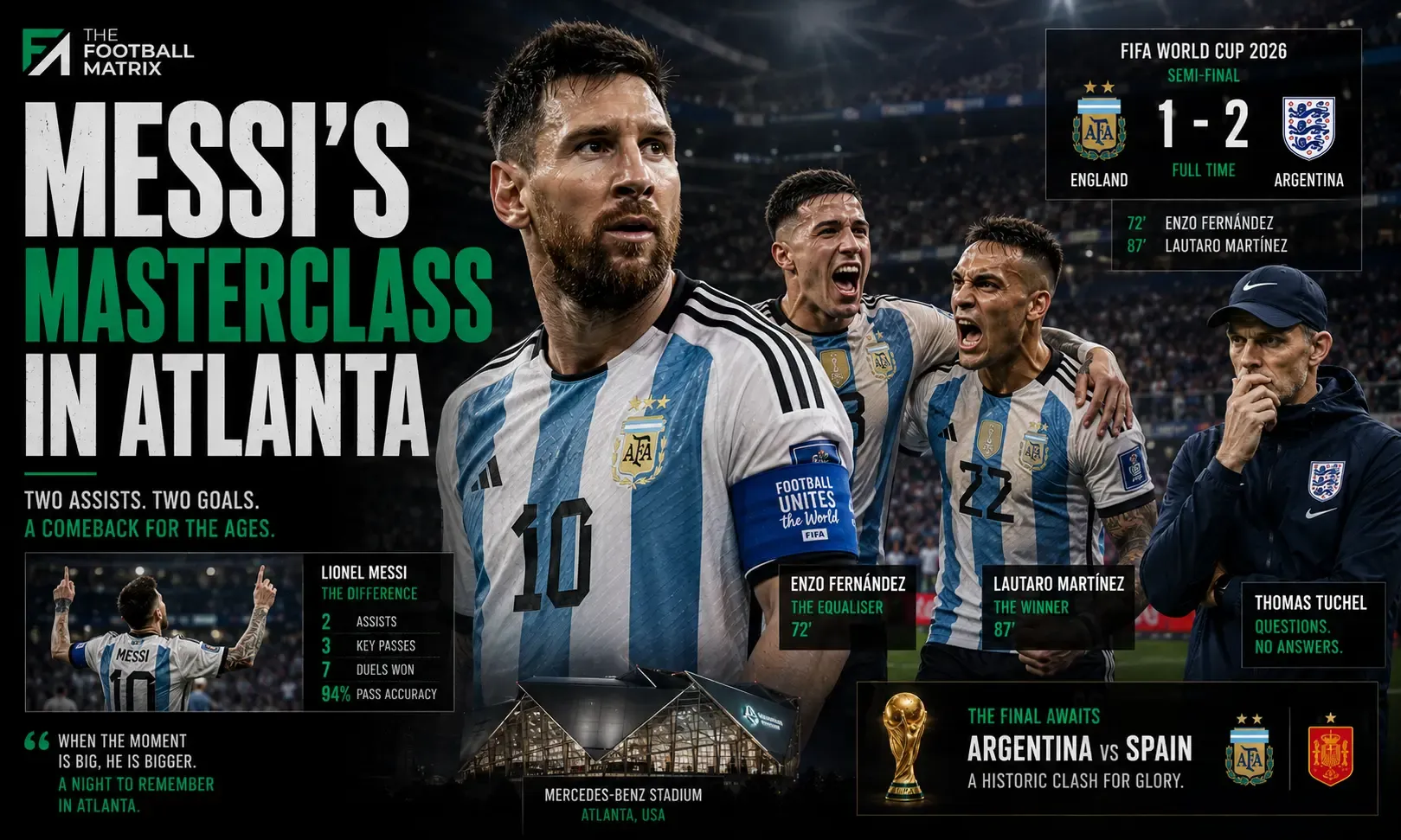
His inswinging corner found Alexis Mac Allister for Argentina's opening goal, registering what was officially his 10th World Cup assist and adding another landmark to an already unparalleled international career.
Unlike many of Messi's iconic tournament moments, this one relied less on individual dribbling brilliance than on technical precision and decision-making. The assist reflected another dimension of his game: consistently delivering quality in decisive moments, regardless of whether the contribution comes through spectacular skill or intelligent execution.
Although Argentina ultimately required extra time, Messi once again shaped the match at its earliest turning point.
4. Europe's Difference-Makers
Merino and Mbappé Deliver Under Pressure
Spain and France both benefited from decisive interventions at key moments.
Mikel Merino once again demonstrated his value as a late-arriving midfielder, timing his movement into the penalty area perfectly to score the decisive goal against Belgium. His ability to attack spaces vacated by defenders focused on Spain's wide threats has become an increasingly important weapon during the knockout rounds.
Kylian Mbappé's contribution against Morocco highlighted a different quality.
After seeing his first-half penalty saved by Yassine Bounou, the France captain responded with the opening goal shortly after the restart, refusing to allow an earlier disappointment to define his performance. Elite forwards are often judged by how they respond to failure as much as by how they celebrate success, and Mbappé once again demonstrated remarkable resilience.
The Case for Caution
Outstanding individual performances should not obscure the broader tactical picture.
Bellingham rescued England, while Álvarez unlocked a match that Argentina had struggled to control despite enjoying numerical superiority. Those moments proved decisive, but they were also exceptional rather than repeatable.
The semi-finals present a different challenge.
France and Spain have generally advanced with greater tactical control and considerably less physical expenditure than Argentina and England, both of whom have required consecutive extra-time victories. Fatigue becomes increasingly significant at this stage of the tournament, reducing the likelihood that individual brilliance alone can repeatedly compensate for structural shortcomings.
The Bottom Line
The quarter-finals reinforced one of football's oldest truths: when tactical systems reach their limits, elite players often determine who progresses.
Bellingham rescued England. Álvarez rescued Argentina. Messi continued to rewrite the record books, while Merino and Mbappé delivered decisive moments for two of the tournament's most complete teams.
As the World Cup reaches its final four, the balance may begin to shift. The semi-finals are likely to reward collective structure more consistently than individual rescue acts. But if the margins remain as fine as they have throughout the knockout stage, it may once again take a single player producing a single extraordinary moment to decide who reaches the final.
Support The Football Matrix on Google Search
Add us as a preferred source to highlight our transfer & injury intelligence in your search results.
☕ Keep The Matrix Running
The Football Matrix is independent — no ads, no paywalls, no corporate sponsors. If our coverage adds value to your matchday, consider buying us a coffee. It goes directly toward hosting, infrastructure, and keeping the editorial free for everyone.
Discussion (0)
Loading comments...