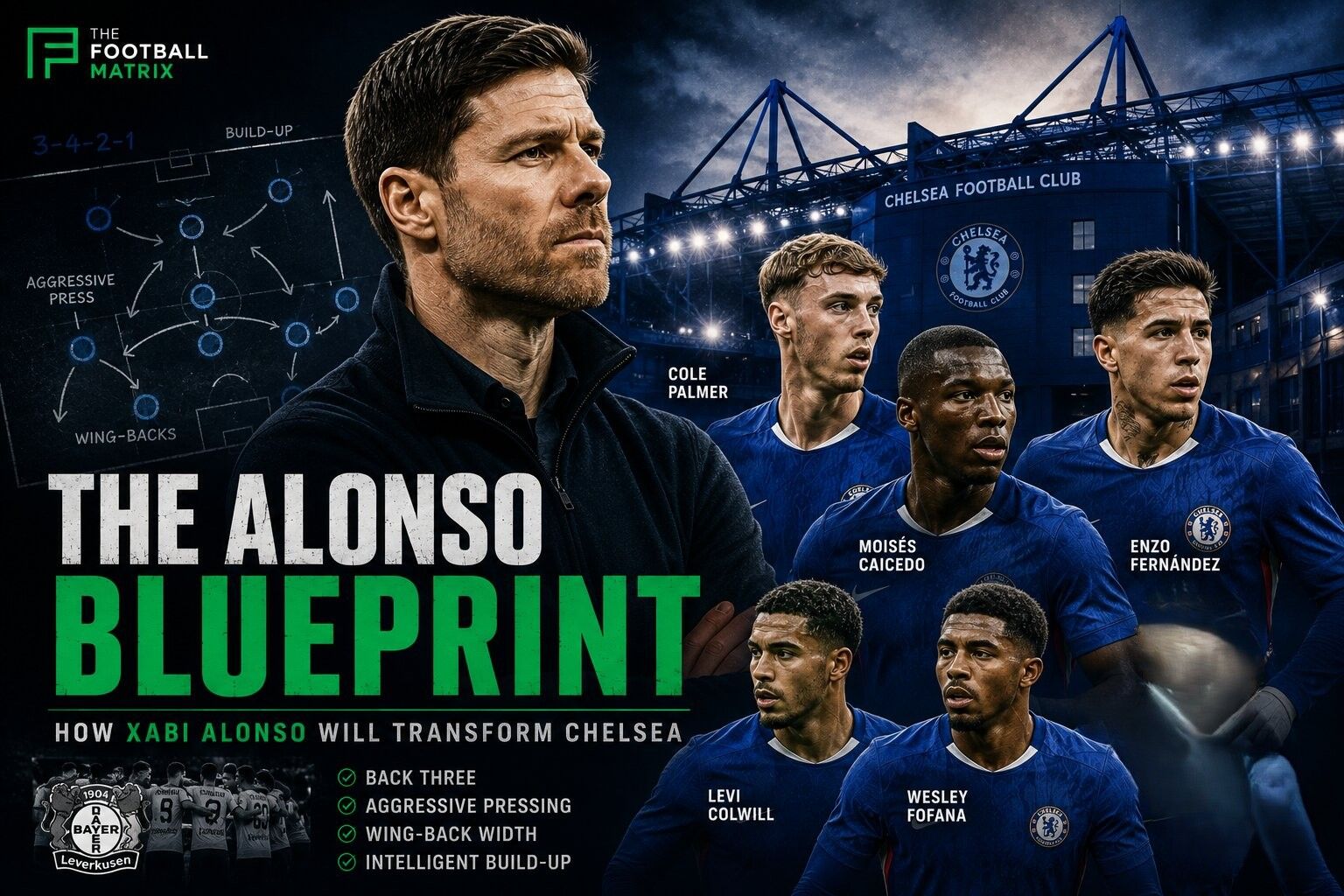
Xabi Alonso's first training sessions at Cobham have offered an early indication of Chelsea's new direction. Rather than refining the positional framework established under Enzo Maresca, the initial emphasis appears to be on installing an entirely different tactical identity. Early reports point towards a fixed back three, intensive positional coaching and a structure designed to create controlled superiority before accelerating attacks into space. It is less an evolution of Chelsea's recent approach than a fundamental reset.
Leverkusen vs. Chelsea: The Tactical Baseline
| Tactical Metric (League Rank) | Alonso's Leverkusen (2023–24) | Maresca's Chelsea (2024–25) |
|---|---|---|
| Average Possession | 62.1% (1st) | 56.8% (4th) |
| Passes per Sequence | 5.01 (1st) | 4.30 (2nd) |
| High Turnovers per Match | 10.8 (1st) | 7.8 (9th) |
| Direct Speed (m/s) | 1.71 (18th) | 1.64 (17th) |
The numbers highlight two possession-oriented teams pursuing different objectives. Alonso's Bayer Leverkusen controlled games through patient circulation before accelerating attacks at carefully chosen moments, while their league-leading high-turnover figures reflected an aggressive pressing structure designed to regain possession high up the pitch. Chelsea also valued possession under Maresca, but generally relied more heavily on controlling territory than forcing turnovers through coordinated pressure.
Xabi is here. 🔵🇪🇸 pic.twitter.com/pfEJnHdI4k
— Chelsea FC (@ChelseaFC) July 9, 2026
1. Dissecting the System
A Permanent Back Three Rather Than Positional Rotation
One of the defining characteristics of Maresca's Chelsea was its flexibility in possession. Full-backs frequently stepped into midfield, allowing the defensive structure to evolve as attacks developed.
Alonso's preferred framework is more consistent. His Leverkusen side typically built, defended and progressed the ball from a genuine back three, reducing the constant positional reshuffling seen in many Guardiola-inspired systems.
Possession itself is not the objective. Instead, it becomes a method of drawing opponents forward before exploiting the spaces created, particularly through adventurous wing-backs stretching the pitch. The patient build-up phase serves to manipulate defensive shape before attacks become significantly more vertical.
2. Projecting Chelsea's New Shape
A Squad Built Around Wing-Backs
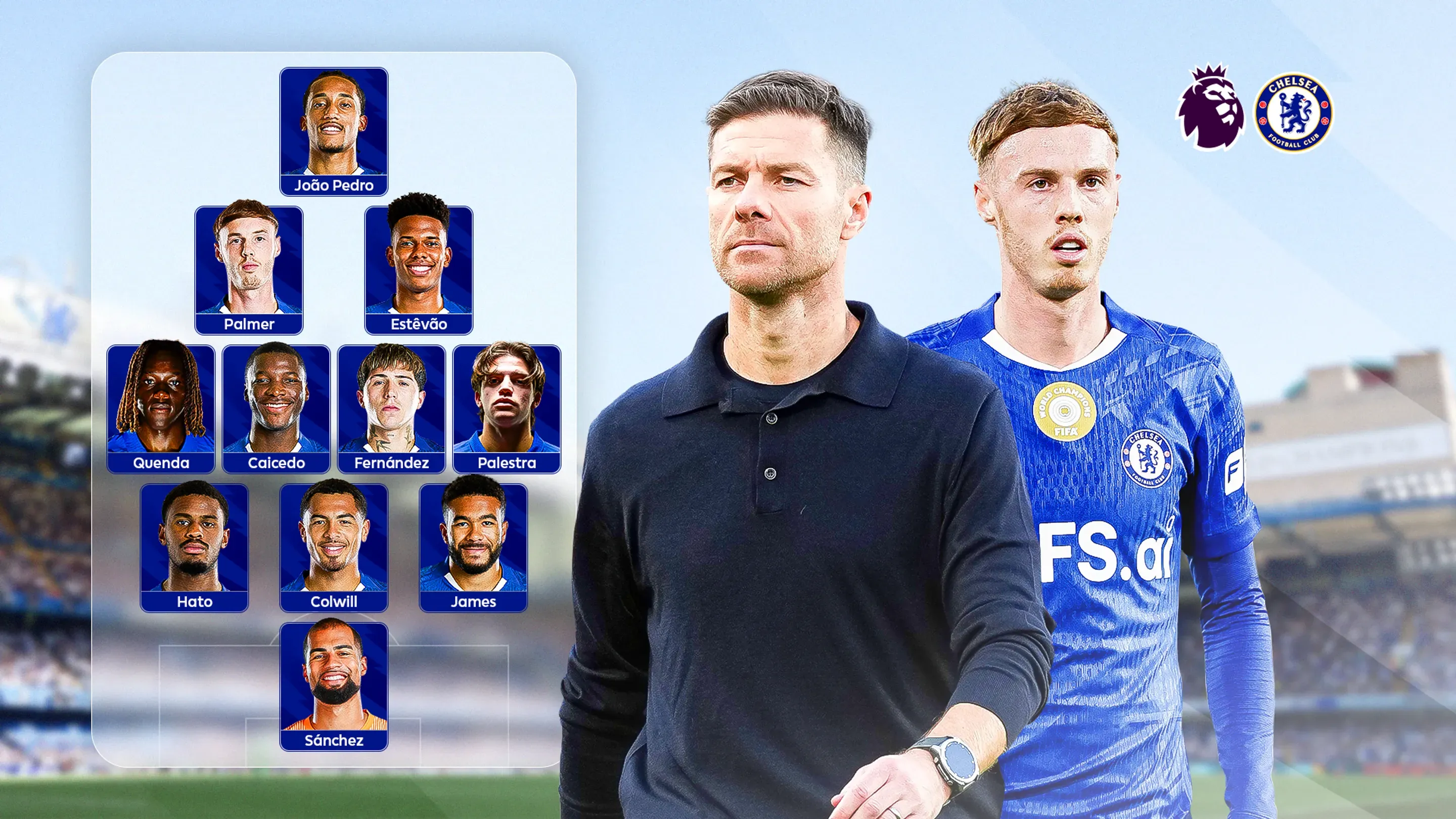
Chelsea's recruitment increasingly appears aligned with these tactical demands.
Marco Palestra brings the athleticism and attacking output expected from an Alonso wing-back, while Geovany Quenda offers another high-intensity option capable of stretching play from wide positions. Together, they provide profiles better suited to generating width through constant movement rather than relying on inverted full-backs.
That shift represents one of the clearest departures from Chelsea's previous tactical identity, with natural width expected to come primarily from wing-backs rather than wide forwards.
3. Palmer's Opportunity
Greater Freedom Between the Lines
Cole Palmer may be one of the biggest beneficiaries of Alonso's structure.
Rather than operating from wide starting positions, he projects more naturally into one of the inside attacking roles behind the striker, occupying the half-spaces where he has consistently produced his best football. The comparison with Florian Wirtz is understandable from a positional perspective, even if their individual qualities differ.
Operating centrally should allow Palmer to receive the ball more frequently between defensive lines while reducing some of the defensive responsibilities that accompanied wider roles under Maresca.
Behind him, however, the midfield dynamic changes considerably.
Instead of splitting responsibilities during defensive transitions, Moisés Caicedo and Enzo Fernández would be expected to operate as a coordinated pairing, pressing aggressively to force turnovers before opponents can establish sustained possession. That collective movement formed a cornerstone of Alonso's Leverkusen and will likely become one of the defining tactical features of his Chelsea side.
4. The Transition Challenges
Adapting the Squad
Changing from a back four to a permanent back three inevitably creates adaptation challenges.
With Marc Cucurella no longer part of the squad, Chelsea's left-sided options face increased physical and tactical demands. Jorell Hato has the attacking qualities suited to wing-back, but sustaining that role across an entire Premier League campaign requires significantly greater defensive coverage than a traditional full-back position.
Central defence also presents important questions.
Levi Colwill and Wesley Fofana are both comfortable progressing possession into midfield, an attribute Alonso values highly. Whether Chelsea possess the ideal central defender to anchor the middle of a three-man defence remains less certain. Organising the defensive line against direct attacks while maintaining aggressive positioning further forward will be an important balance to establish during pre-season.
There are also unresolved selection decisions elsewhere.
Reece James's fitness will influence whether he is used as a right wing-back or as the right-sided centre-back, while the competition between Robert Sánchez and Filip Jørgensen for the goalkeeper position carries greater tactical significance in a system that relies heavily on distribution from deep.
Patience Will Be Required
Day one. pic.twitter.com/3h6MPziUlI
— Chelsea FC (@ChelseaFC) July 9, 2026
Implementing a new tactical framework takes time, regardless of managerial pedigree.
Alonso's ideas are well established after his success at Leverkusen, but replicating those principles with a different squad in a more demanding league inevitably involves an adjustment period. Training-ground repetition can accelerate that process, yet competitive matches often expose details that cannot be fully replicated in pre-season.
The early weeks of the Premier League campaign are therefore likely to provide the clearest indication of how quickly Chelsea's players have adapted to the structural demands of Alonso's system.
The Bottom Line
Chelsea's summer increasingly resembles a coordinated tactical rebuild rather than a conventional managerial change. Recruitment has been aligned with a clearly identifiable playing style, and the early signs suggest Alonso is prioritising structure before individual expression.
Questions remain over personnel, particularly in central defence and the wing-back positions, while several key selection decisions have yet to be settled. Even so, Chelsea appear to have entered pre-season with a coherent footballing vision—something that often proves just as valuable as the individual quality of new signings.
Whether that vision translates into immediate results will depend less on the tactical blueprint itself than on how quickly the squad can execute it once the Premier League season begins.
Support The Football Matrix on Google Search
Add us as a preferred source to highlight our transfer & injury intelligence in your search results.
Discussion (0)
Loading comments...