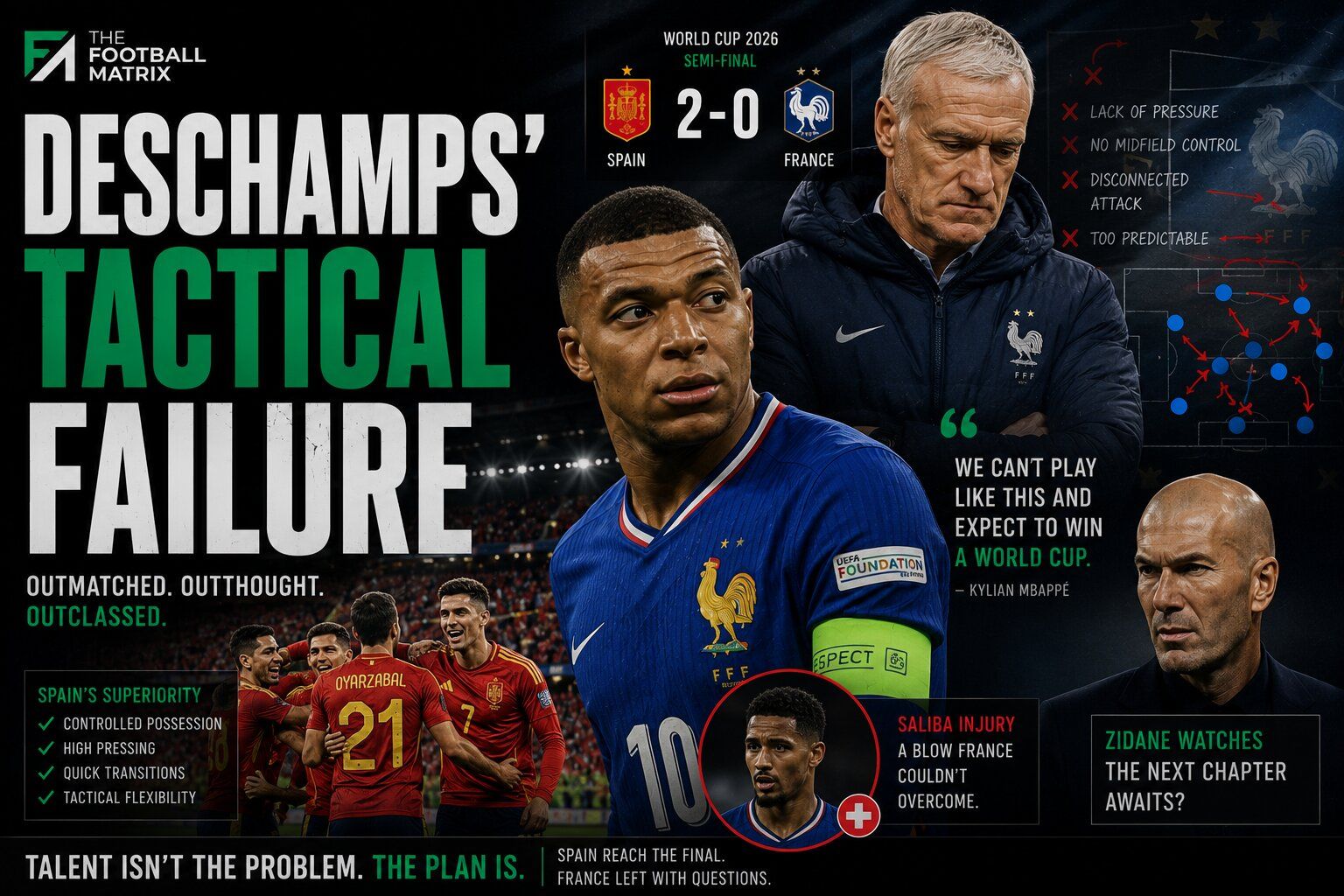
Didier Deschamps spent fourteen years being told he was too cautious, too rigid, and too willing to sacrifice Kylian Mbappé, Antoine Griezmann, and other attacking talents in favor of defensive solidity and control. In his final major tournament, he finally listened and built a team around his attackers rather than in spite of them.
It cost him the World Cup.
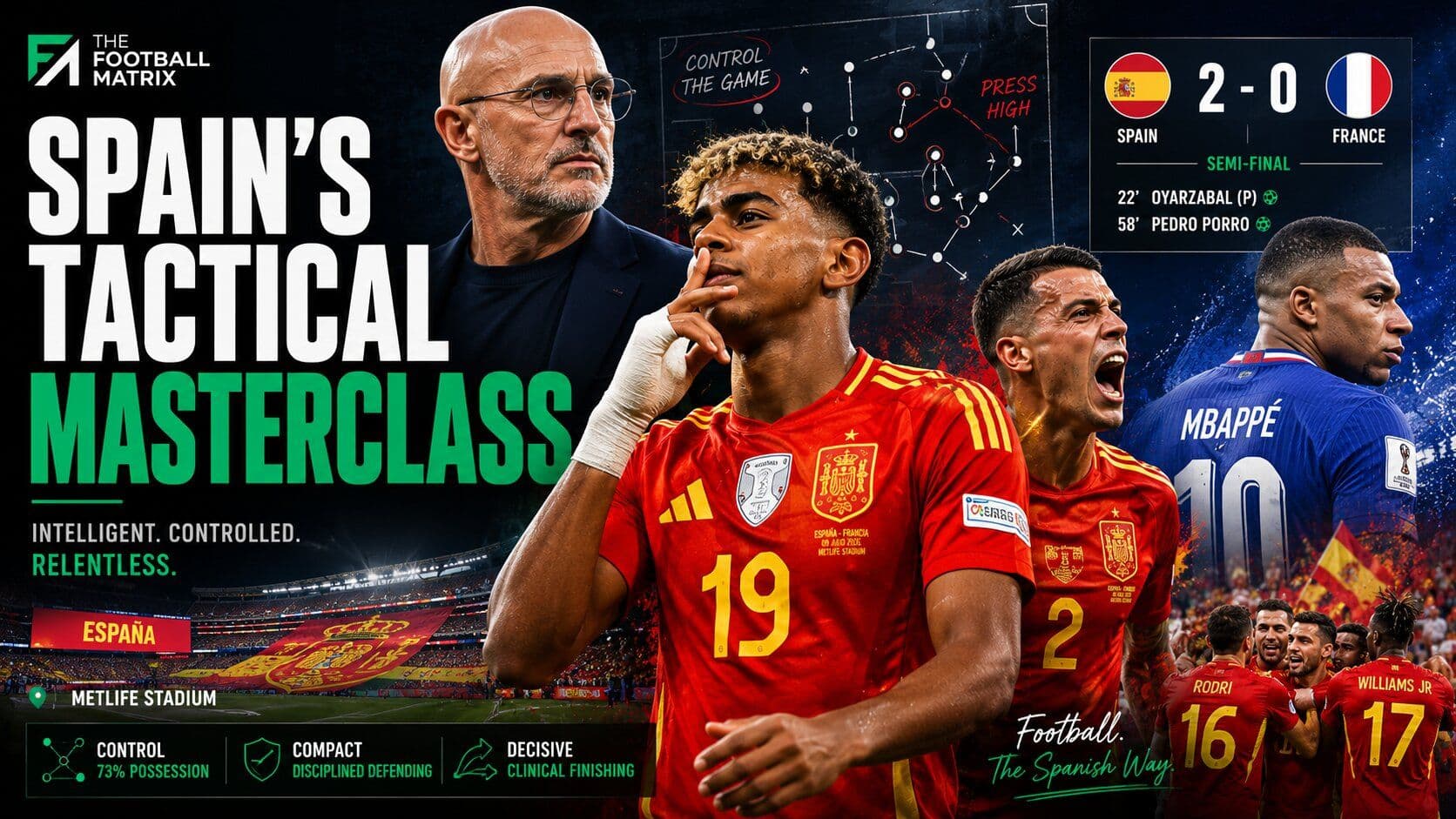
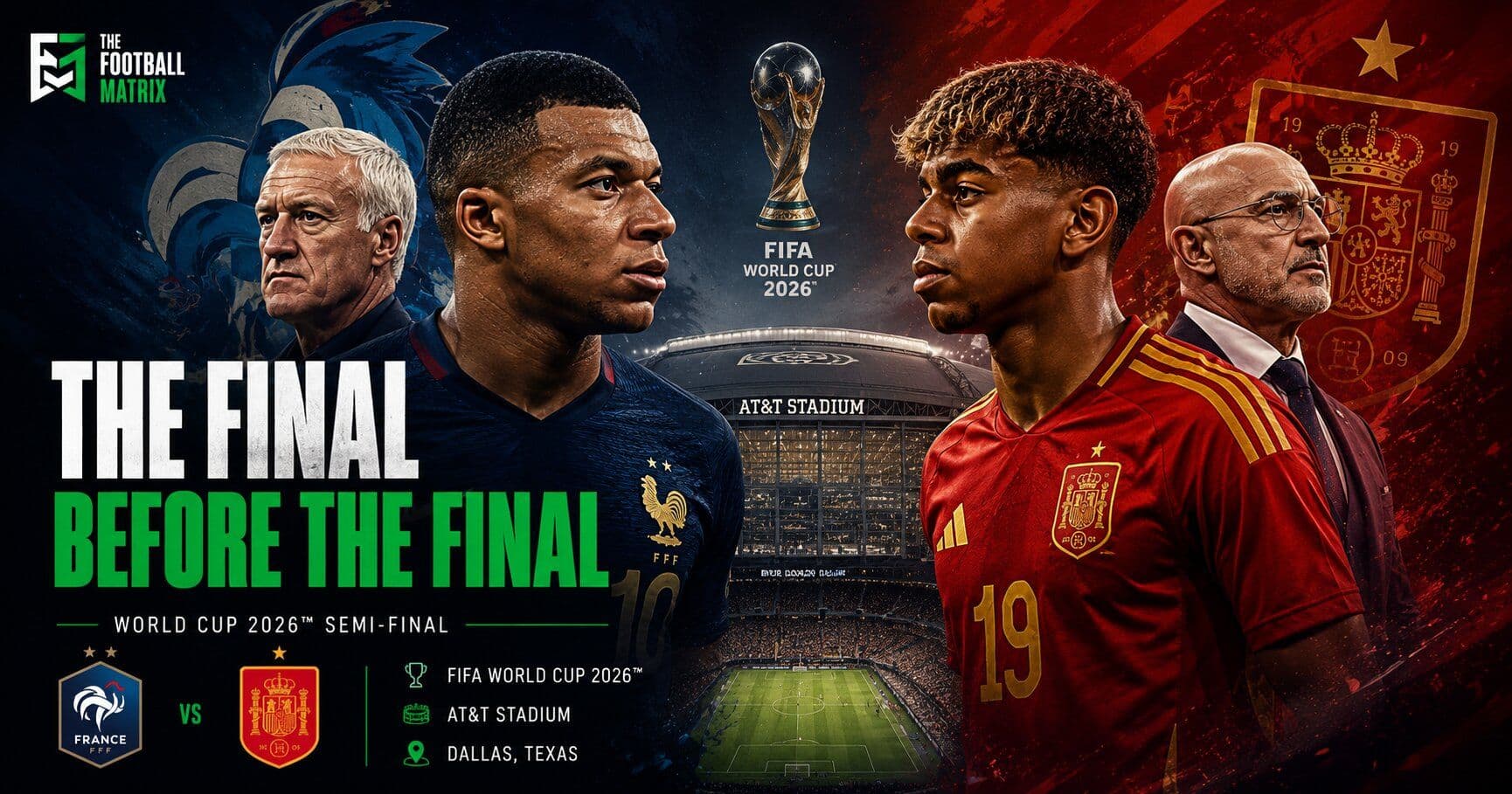
France arrived in Dallas as the tournament's most discussed attacking unit, a side many neutrals had penciled in as the team to beat. They left AT&T Stadium after managing just two shots on target across ninety minutes, watching Spain progress to a third consecutive semi-final victory over Les Bleus in competitive meetings. The scoreline read 2-0, but the performance revealed a deeper issue about what happens when a defensively-minded coach abandons the principle that has kept his team competitive for over a decade.
This wasn't simply a case of Spain being better on the day—though Luis de la Fuente's side certainly were. It was a structural failure, engineered by Deschamps' own hand, that Spain's midfield trio exploited with a level of precision suggesting they had scouted the exact weakness for weeks.
The 3v2 Trap: How De la Fuente Overran the French Engine Room
The formation on paper looked innocuous enough. France's 4-2-3-1, with Ousmane Dembélé, Michael Olise, and Bradley Barcola flanking Mbappé, aimed to overwhelm Spain with pace and directness. In practice, it meant Aurélien Tchouaméni and Adrien Rabiot were left to cover the entire midfield with almost no support from the four players ahead of them.
The Isolation of Tchouaméni and Rabiot
None of France's front four showed much appetite for tracking back. That’s understandable to an extent—Deschamps constructed this iteration of the side specifically to attack, and asking Dembélé or Barcola to defend deep would have undermined the entire project. However, it created a gaping hole between the front line and the double pivot, and Spain identified it within the opening ten minutes.
Each time Tchouaméni or Rabiot stepped forward to close down the ball, they left space behind them for Dani Olmo or Fabián Ruiz to exploit. Close one gap, and another opens. That’s the nature of being outnumbered—you're always a half-second late.
Rodri and Fabián Ruiz: Masters of Rest Defense and Tempo
The mechanism behind Spain's control was Dani Olmo dropping from his advanced role to form a passing triangle with Rodri and Ruiz. This was no longer a double pivot; it became three central midfielders against two, and against players of that quality, a numbers deficit in midfield is nearly fatal.
The passing statistics underscore this without needing much interpretation: Spain completed 487 passes to France's 408, a gap that reflects who dictated the tempo of the game. Spain weren't interested in matching France's pace; they aimed to strangle it. Whenever France threatened to turn the match into transitions—the exact conditions where Mbappé and Dembélé are most dangerous—Spain recycled the ball through Rodri and Ruiz until the moment passed.
Rodri and Ruiz had, in Mbappé's own words after the match, "plenty of time to play." When two midfielders of that caliber are given time rather than pressure, they don't waste it. They probed the half-spaces, pulled Tchouaméni out of shape, and fed the runners in behind at will.
The Ticking Time Bomb: William Saliba's Injury and the Lacroix Deficit
If the midfield imbalance was a pre-existing condition, William Saliba's injury was the moment France's spine snapped entirely.
"My Back is Gone": The 29th-Minute Turning Point
In the 29th minute, Saliba went down clutching his lower back without any contact involved. Cameras caught him mouthing the words "my back is gone" as he was helped off the pitch. This wasn't an isolated incident; Saliba has managed a chronic back problem since it first flared during Arsenal's Champions League final defeat to PSG. There had been quiet concern within the France camp about whether he could endure a full tournament run. On this night, in the most significant game of his career, the issue resurfaced at the worst possible moment.
His departure mattered for reasons beyond the obvious defensive reshuffle. Saliba's recovery speed allowed Deschamps to play a high defensive line, compressing the pitch and denying Spain's attackers room to turn and run. Losing that pace at centre-back meant losing the entire defensive geometry France had built around him—not just a player, but a mechanism.
Maxence Lacroix and the Cost of Lack of Depth
Maxence Lacroix, on for his World Cup debut in the most hostile circumstances imaginable, was targeted almost immediately. Spain's second goal exemplified this exploitation: Dani Olmo made a vertical decoy run that dragged Dayot Upamecano out of position, and Lacroix—lacking the positional instincts built over years of pairing with Upamecano—failed to recognize the space that opened up. Pedro Porro made an underlapping run straight through the vacated channel and finished from close range.
It's challenging to fault Lacroix for a lack of experience in a role for which he wasn't prepared. However, it's harder still to ignore that France's defensive depth simply wasn't constructed to withstand losing Saliba in a semi-final.
Pocketed and Frustrated: How Pedro Porro and Pau Cubarsí Neutralised Mbappé
Deschamps' captain didn't just fail to influence the game; he barely appeared in it.
Staggered Fullbacks vs. Broken-Field Transitions
Spain's rest defense was specifically designed to deny France the broken-field moments where Mbappé typically thrives. Porro and Marc Cucurella were never both advanced at the same time—when Porro pushed forward to combine with Lamine Yamal, Cucurella tucked in alongside Pau Cubarsí and Aymeric Laporte to form a back three. This discipline meant that even when France regained possession, there was no space to sprint into.
This forced Mbappé to receive the ball with his back to goal in tight areas against a 19-year-old Cubarsí, who repeatedly stepped up to win the physical and positional battle. It was a role reversal from the usual script, where Mbappé's pace terrorizes defenders in transition. Here, he had nowhere to run.
The Statline of a Ghost: Mbappé's Night to Forget
The numbers are stark: zero shots on target, zero chances created, one completed take-on, and just 12 completed passes from 34 touches across the full ninety minutes. For a player chasing the Golden Boot with eight goals coming into the match, it was as complete a shutdown as any elite forward has suffered in this tournament.
He wasn't alone. Michael Olise, the tournament's leading creator with five assists before kick-off, managed only two chances created and zero successful dribbles in 72 minutes before being withdrawn. Spain's compact block didn't just handle Mbappé individually; it choked off the central passing lanes that had fed France's front four throughout the tournament.
Tactical Mutiny: Mbappé's Post-Match Words and the End of the Deschamps Era
What occurred after the final whistle may end up defining this match as much as anything that happened during it.
"We Were Three Against Two": Captain vs. Coach
Speaking to reporters afterward, Mbappé didn't hide his frustration with the setup his manager had chosen.
"We were three against two in midfield, and against Spain, that's hard... Fabián and Rodri had plenty of time to play."
That is not the language of a captain protecting his coach. It is a direct, public identification of the exact tactical flaw this article has laid out—numerical inferiority in central midfield caused by a front four that offered no defensive cover. For a player who has generally been diplomatic about tactical matters throughout his career, the specificity of the criticism was notable. This reads less like frustration in the heat of the moment and more like a considered indictment of a plan Mbappé didn't believe in.
There is an obvious counterpoint here: Deschamps had spent over a decade being criticized for exactly the opposite sin—being too cautious, too willing to blunt his attacking talent for defensive security. Had he selected a more conservative midfield trio and lost 1-0, the same voices now praising his attacking intent might well have accused him of squandering a golden generation. Deschamps chose the version of this squad the public had demanded for years. Against a Spanish side unbeaten in 90 minutes across 36 matches, the reigning European champions, that version wasn't good enough—but that reflects as much on Spain's structural excellence as it does on French naivety.
Deschamps himself didn't fully accept the tactical critique in his post-match remarks, instead directing some frustration at El Salvadoran referee Iván Barton, questioning whether he was "up to the task" of officiating a World Cup semi-final. Whether that is a fair reflection of Digne's clumsy foul on Lamine Yamal, which gifted Spain their opening goal from the penalty spot, is a separate conversation—but it did little to quiet the sense that the manager and his captain weren't on the same page.
Zidane Waits in the Wings: What Lies Ahead for Les Bleus
Deschamps' departure was already confirmed before a ball was kicked in Dallas—he will step down after Saturday's third-place playoff in Miami Gardens, ending a 14-year reign that included the 2018 World Cup and the 2022 final. Zinedine Zidane has a verbal agreement with the FFF to take over, inheriting a squad that is talented, fractured, and now publicly questioning the tactical framework it just competed under.
What Zidane actually does with that inheritance is the more interesting question. A midfield double pivot exposed to 3v2 overloads by elite opposition is a fixable problem—whether through personnel, demanding more defensive discipline from the front four, or returning to a back-three system that offers natural cover. Zidane's own playing career suggests an instinct for control in midfield rather than chaos, and reports from within France's base camp already indicate friction over Deschamps' training intensity and tactical rigidity, even amid his attacking overhaul. Whoever succeeds him will be working with players who have just experienced firsthand what happens when that control disappears.
The Bottom Line
There’s a cruel symmetry to how Deschamps' France era ends. The manager who was pilloried for years as overly defensive, who dragged France to a World Cup final in 2022 playing largely on the counter, finally gave his most gifted generation the attacking framework supporters had clamored for—and it unraveled against the one opponent structured enough to punish every gap it created. Spain didn't need to be spectacular; they needed to be patient, disciplined, and precise, and they were all three.
Saliba's injury deserves acknowledgment as a genuine mitigating factor; no game plan survives losing its defensive foundation in the 29th minute unscathed. Yet the midfield imbalance existed before Saliba went down, and it would have persisted regardless of who lined up at centre-back. France now turns to Saturday's third-place playoff in Miami Gardens as a strange coda to Deschamps' reign, before Zinedine Zidane inherits a squad that is undeniably talented, evidently divided on tactical philosophy, and searching for the balance between control and freedom that eluded it in Dallas.
Support The Football Matrix on Google Search
Add us as a preferred source to highlight our transfer & injury intelligence in your search results.
☕ Keep The Matrix Running
The Football Matrix is independent — no ads, no paywalls, no corporate sponsors. If our coverage adds value to your matchday, consider buying us a coffee. It goes directly toward hosting, infrastructure, and keeping the editorial free for everyone.
Discussion (0)
Loading comments...