Pedro Porro's 58th-minute strike in Dallas not only secured a 2-0 victory over France but also confirmed a significant evolution in Spain's footballing philosophy that has been developing over four years. They have successfully addressed a challenge that plagued their golden generation a decade ago: dominating possession while maintaining a robust defensive structure.
That semi-final win, sealed by Mikel Oyarzabal's early penalty and Porro's second-half finish, propelled La Roja into their first World Cup final since 2010. It also extended their unbeaten run in regular and extra time to 37 matches, matching Italy's record streak from 2018 to 2021. Statistics like these often invite simplistic explanations—luck, momentum, or a favourable draw—but none of these apply here. Spain has conceded just one goal in six matches at this tournament, a testament to the tactical structure that Luis de la Fuente has meticulously refined throughout his tenure.
This is not the tiki-taka of Xavi and Iniesta, characterized by patient ball circulation to the point of monotony. Instead, it is a faster, more vertical style—crucially designed with defensive transitions in mind from the first pass.
Beyond Tiki-Taka: The Shift to Vertical Possession
The Spain teams of 2018 and 2022 controlled matches without effectively managing danger. They circulated the ball across the pitch, often leaving themselves exposed when possession was lost in advanced areas. Croatia and Morocco exploited these vulnerabilities in recent tournaments.
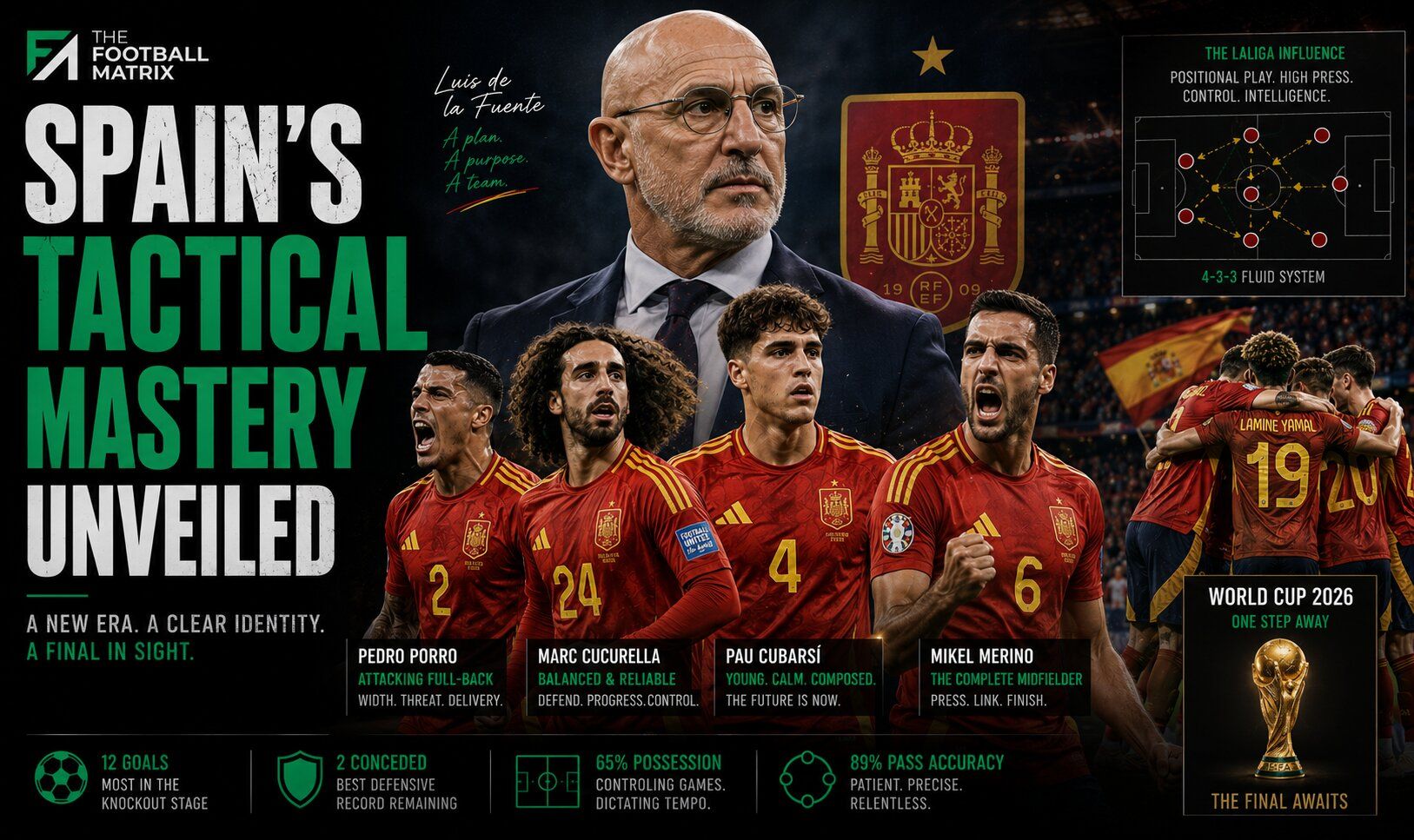
The version that defeated France maintains a 66.0% average possession share—leading the tournament—but the ball moves with greater purpose. Passes are played forward before moving sideways. Spain treats possession as both an attacking weapon and a defensive tool—holding the ball not only to create chances but also to deny opponents the transitions needed to exploit a high defensive line.
The foundation of this approach was laid at Euro 2024, where Spain first showcased this quicker, more purposeful passing pattern. Since then, the counter-press has evolved significantly. At this World Cup, Spain regains possession in the attacking third an average of 7.8 times per match—a figure reflecting coordinated pressing triggers rather than individual chasing. If Spain loses the ball in the final third, five or six players converge within seconds. This pressing discipline, as much as the passing itself, transforms their possession from sterile to suffocating.
The Inverted Blueprint: Porro, Cucurella, and the Midfield Box
The mechanism behind Spain's control begins at full-back, diverging sharply from traditional wing-back play.
Creating the Numerical Overload
When out of possession, Spain adopts a recognizable 4-3-3 or 4-2-3-1 shape. In possession, however, Pedro Porro and Marc Cucurella abandon the touchline almost entirely. Instead of overlapping into wide spaces, they tuck inside into half-spaces and central midfield channels, reshaping Spain's formation into a 3-2-5 or 2-3-5.
The purpose is straightforward: create numerical overloads in the middle of the pitch, rendering the opposition's press unable to cover every passing lane. With Porro and Cucurella moving infield alongside Rodri and Fabián Ruiz, Spain regularly fields a four- or five-man presence in central areas against opponents who are often outnumbered. Bypassing the first line of pressure becomes a routine affair.
Freeing the Interiors
This inversion offers a quieter but significant benefit. With full-backs occupying central zones, Rodri—led by 2024 Ballon d'Or winner Rodri—is relieved from the responsibility of covering wide areas, allowing him to focus solely on dictating tempo from deep. Fabián Ruiz, playing higher and more aggressively than a typical double pivot, is licensed to advance into the left half-space and support attacks rather than merely recycling possession. Dani Olmo, in turn, operates almost as a second striker when Spain commits numbers forward.
The result is a midfield that consistently dominates territorial battles, regardless of the opponent.
Shuts, Locks, and Bolts: The Rest-Defence Fortress
This tactical framework would be ineffective if Spain conceded space every time possession was lost. They do not, which distinguishes this squad from previous Spanish sides.
The Structure Behind the Numbers
Because Porro and Cucurella invert rather than overlap, Spain maintains a minimum of five players positioned behind the ball during attacking phases—comprising the two centre-backs, both inverted full-backs, and Rodri sitting just in front of them. This "rest-defence" shape ensures that even if the initial counter-press is bypassed, a secondary defensive line is already in place to intercept passes or delay opposing runners.
Against France, this structure was pivotal. Kylian Mbappé, arguably the tournament's most dangerous transition threat, found little space to exploit throughout the match. Spain's defensive organization effectively nullified his ability to thrive in isolation.
The statistics illustrate the effectiveness of Spain's defensive setup: one goal conceded in six matches, and prior to Belgium's quarter-final equaliser from Charles De Ketelaere, more than ten hours of World Cup football without conceding. This record is not a product of luck; it stems from a repeatable defensive structure that has held firm under pressure from Portugal, Belgium, and France.
Pau Cubarsí, Nineteen and Unshaken
At the heart of this defensive structure is Pau Cubarsí, who has started all six matches and played every minute of Spain's knockout campaign. His composure under pressure belies his age. Cubarsí's value extends beyond defending crosses or winning duels; he is willing to receive the ball under pressure in his own half and execute line-breaking passes into midfield rather than simply clearing danger. This comfort on the ball is crucial to Spain's rest-defence functioning as a passing structure rather than a purely defensive one. Remove his composure, and the entire system loses a layer of its build-up quality.
The "Attract to Isolate" Strategy on the Flanks
Spain's control extends beyond mere possession share; it concerns where they direct their opponents' focus.
A consistent pattern emerges: Spain overloads the left flank, cycling short, patient passes among Cucurella, Fabián Ruiz, and Alex Baena. The deliberate lack of urgency in this circulation aims to draw the opponent's defensive block across the pitch, forcing them to shift compactly.
Once the block is fully committed to the left, Spain executes a rapid vertical switch to the right—directly into space in front of Lamine Yamal. The teenager, whose rise has made him one of the tournament's genuine box-office attractions (the rise of Lamine Yamal as a global superstar), finds himself in a 1v1 situation against an isolated full-back, with no covering support arriving in time.
The quarter-final against Belgium demonstrated the effectiveness of this strategy even without a landslide scoreline. Spain outshot Belgium 17 to 5—a margin indicative of how the match often resembled a training exercise rather than a knockout tie, despite the final score not reflecting this.
Mikel Merino and the Science of the Late Introduction
If the first four sections elucidate how Spain controls matches, this section details how they finish them.
De la Fuente strategically reserves Mikel Merino for late introductions, typically around the 85th minute, against opponents who have spent the previous hour retreating deeper and tiring under Spain's territorial pressure. Merino's profile—characterized by aerial strength, physical directness, and sharp instincts around second balls—is ideally suited for these moments rather than for 90 minutes of build-up play.
The results have been consistently impressive. Merino scored a 90+1' winner against Portugal in the round of 16 and followed it with an 88th-minute winner against Belgium in the quarter-final—becoming the first player in World Cup history to score late knockout-stage winners as a substitute in two separate matches during a single tournament.
"Mikel is super complete, very versatile. He can be the best striker, the best second striker, the best midfielder. Why? Because he scores when it matters most." — Luis de la Fuente
This approach reflects calculated squad management as much as tactical decision-making—De la Fuente acknowledges that Merino's value is maximized in short, high-intensity bursts against fatigued opponents rather than diluted across a full ninety minutes.
Where the System Can Still Be Broken
Despite their successes, Spain remains susceptible to criticism, and the tournament has highlighted potential areas for vulnerability.
The opening group-stage draw against Cape Verde was revealing. Faced with a deep, compact block unwilling to transition forward, Spain occasionally reverted to the slower, horizontal circulation reminiscent of past tournaments—patient possession lacking genuine penetration. Against a side content to absorb pressure, the vertical patterns that effectively unlock better teams did not always materialize.
There is also a structural risk inherent in Spain's high defensive line. While the rest-defence has been exemplary, its effectiveness hinges on the counter-press winning the initial battle after losing possession. When this press is breached—as briefly occurred against Belgium—a well-timed run behind can exploit vulnerabilities. De Ketelaere's goal served as clear evidence that, for all its coherence, the system is not foolproof.
Additionally, personnel choices spark debate. Fabián Ruiz's physicality and vertical running have been preferred over Pedri's passing range throughout the knockout stages, a decision that has proven effective. However, some argue that Pedri's creativity remains an untapped resource on the bench—an omission that could prove costly if Spain finds themselves needing to chase an early goal in the final.
The Road to Immortality
Spain arrives at MetLife Stadium on July 19 with a squad shaped by deliberate decisions—notably a 26-man roster that featured no Real Madrid players upon selection, which includes Marc Cucurella, who made the squad as a Chelsea player but has since transferred to Los Blancos, a historic first that underscores how thoroughly De la Fuente has restructured this generation around his tactical priorities rather than reputations.
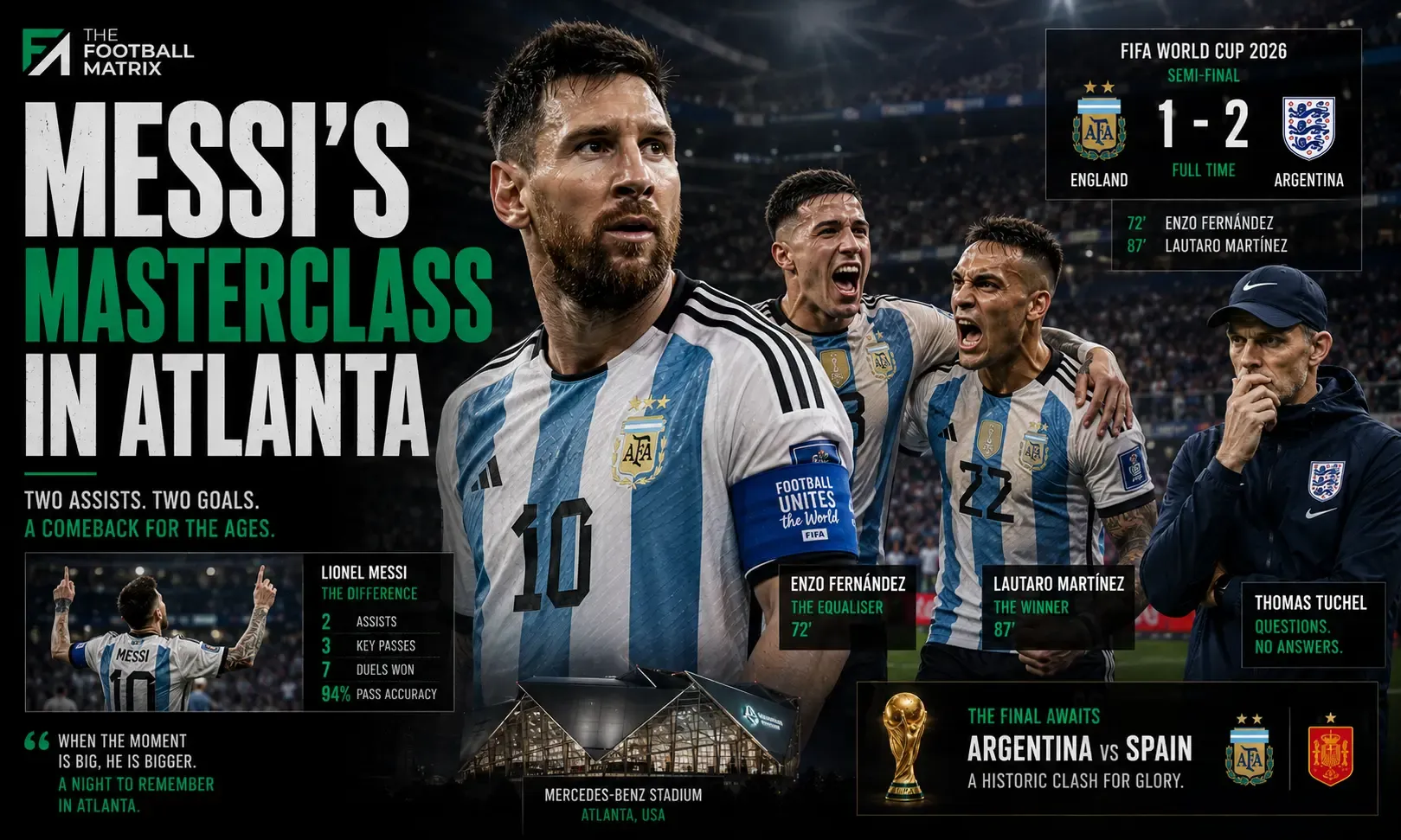
Whoever emerges from the England-Argentina semi-final will face a Spanish side that has conceded just once in six matches, matched the longest unbeaten run in international football history, and constructed a system with effective answers to the challenges that previously exposed Spanish sides at this level. Whether this system will hold for ninety more minutes—against a rested opponent following an intense evening in Dallas—remains a variable that cannot be predicted.
A second World Cup star, to accompany the European Championship title won at Euro 2024, would place this Spanish side in a territory no international team has previously reached. The tactical framework is established. Now it requires one more performance to fulfil its potential.
For a more in-depth report of the France vs Spain Semi-Finals match, read the World Cup 2026 Semi-Final Analysis.
Support The Football Matrix on Google Search
Add us as a preferred source to highlight our transfer & injury intelligence in your search results.
☕ Keep The Matrix Running
The Football Matrix is independent — no ads, no paywalls, no corporate sponsors. If our coverage adds value to your matchday, consider buying us a coffee. It goes directly toward hosting, infrastructure, and keeping the editorial free for everyone.
Discussion (0)
Loading comments...