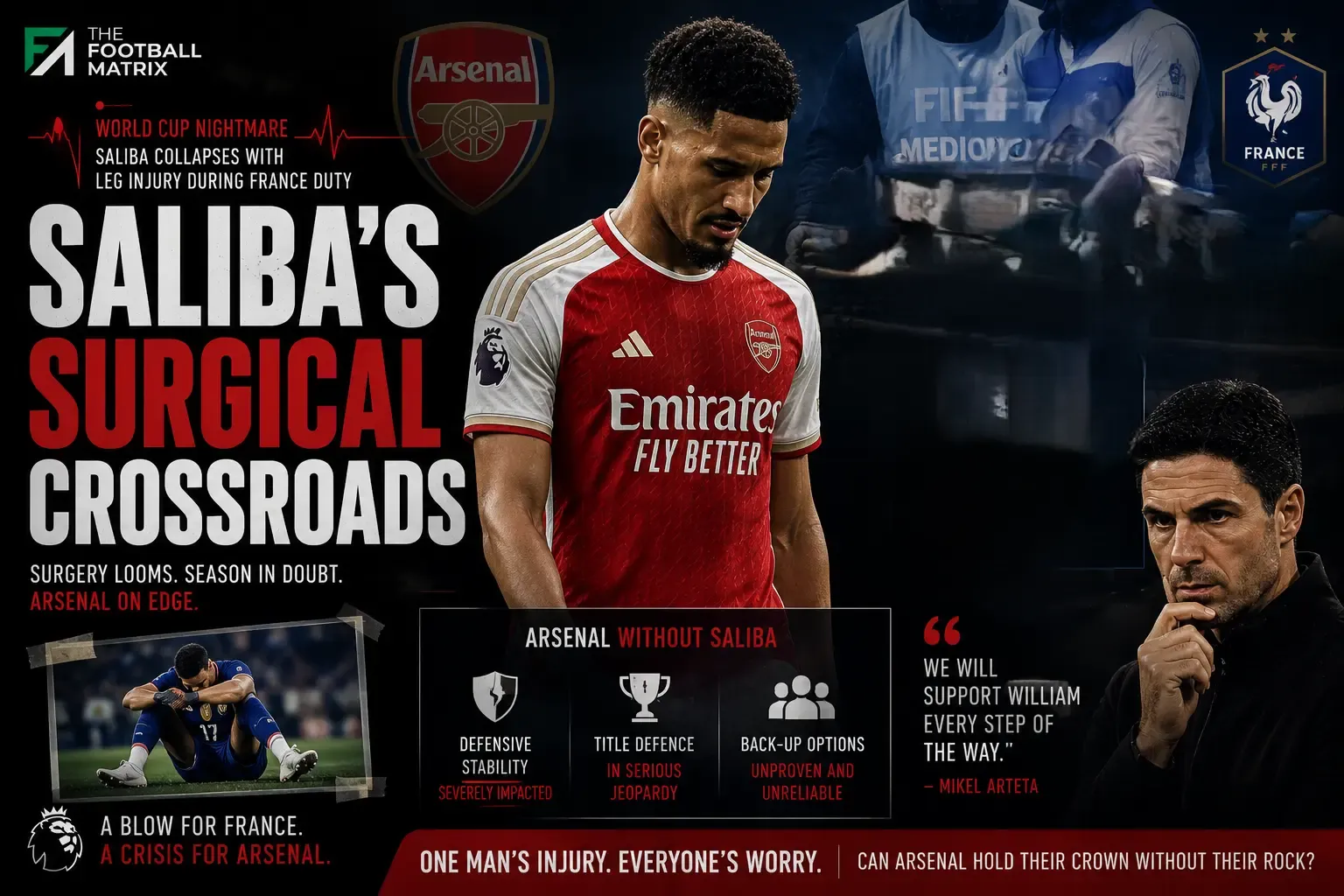
William Saliba goes down under no contact at all. No collision, no tackle, no aerial duel gone wrong. He simply collapses, and the images that follow tell a story the medical bulletins won't. Distressed, he turns to Dayot Upamecano and says the words that will define Arsenal's next five months: "I can't take it anymore, my back is finished."
France lost that semi-final 2-0 to Spain, but for Arsenal supporters, the result was almost secondary to what transpired in those 29 minutes. The prevailing narrative in the days that followed framed this as misfortune — a cruel twist for a player who had already given so much to reach a World Cup semi-final. This framing is misguided, and it is crucial to highlight why. Saliba's back has been a documented concern since his teenage years. He played more than 50 matches for Arsenal last season and spent six weeks at the World Cup managing that chronic issue with painkillers rather than rest. What happened in Dallas wasn't an accident; it was the predictable conclusion of a physical gamble that too many parties — the club, the country, and the player alike — continued to take.
Arsenal now faces a four-to-five-month absence for their best defender, which could cost them as many as 27 matches across all competitions. Mikel Arteta doesn't need sympathy for that; he needs a plan.
Playing Through the Pain: The World Cup Painkiller Protocol
The detail that should trouble Arsenal fans most isn't the collapse itself — it's what led to it. Saliba spent the tournament gritting his teeth through discomfort that his medical staff clearly understood was serious. Anti-inflammatory painkillers allowed him to participate in matches, while recovery sessions were skipped entirely, presumably because the trade-off between short-term availability and long-term structural integrity had already tilted decisively toward "get through the next game."
Managing the Long-standing Spinal Locking
What's notable here is that France's medical staff weren't operating on different information than Arsenal's. Reports suggest they followed nearly identical high-risk management protocols, sharing medical logs and working from the same understanding of Saliba's condition. This consistency is almost more damning than negligence would have been. This wasn't a communication breakdown between club and country; both institutions were aware of the issue they were managing and concluded that a restricted training program and pharmaceutical intervention were sufficient to guide a chronic spinal issue through a World Cup. A group-stage match against modest opposition is one form of load; a semi-final against Spain, played at the intensity international football demands in the biggest games, is another entirely. The gap between those two scenarios is where Saliba's back ultimately gave way.
The Five-Month Void: Mapping the Arsenal Fixture Casualty List
Arsenal is now planning for Saliba to miss the entirety of August through December. In raw terms, that's a projected 27 matches — not merely a rotation issue, but a structural one that impacts every competition simultaneously.
The Cost to Arteta's Title Defense
The number that should concern Arteta most isn't just the match count; it's this: Arsenal's win percentage drops to roughly 50% in matches Saliba doesn't play, a significant decline from their title-winning baseline. This statistic doesn't exist in a vacuum — it reflects Saliba's actual contributions on the pitch. His ability to defend isolated wide corridors in a high defensive line, reading through-balls and recovering at a pace few centre-backs can match, is precisely what enables Arsenal to press aggressively without leaving space in behind. Remove that, and the entire defensive structure must be recalibrated, not just patched.
The timing compounds the problem. Saliba's absence spans Arsenal's Champions League group stage in full, along with away trips to Anfield and the Tottenham Hotspur Stadium — fixtures where his aerial and ground-covering qualities have historically been decisive. Losing him for a series of comfortable home games against mid-table sides would be manageable. Losing him for this particular block of fixtures presents a different challenge altogether.
The Transfer Response: Activating the Replacement Shortlist
Arsenal's recruitment department isn't starting from zero. The club had already moved for Piero Hincapié, signing the versatile left-sided defender from Bayer Leverkusen for £34.5 million before Saliba's injury became a factor. That deal now appears shrewder than it did a fortnight ago, even if Hincapié wasn't signed with this specific crisis in mind.
Integrating Hincapié and the Hunt for Konsa
The question is whether Hincapié, more comfortable operating from the left of a back three or at left-back, can be trusted in the central role Saliba vacates. Jurriën Timber offers another internal option, and his versatility across the back line has been one of Arteta's more useful tools over the past year. However, neither, on current evidence, replicates what Saliba specifically provides against elite opposition behind a high line.
That's why Arsenal has reopened conversations around Ezri Konsa. The Aston Villa defender offers a more direct, like-for-like profile alongside Gabriel Magalhães, and preserving central depth is clearly the priority now rather than adding further width. Whether the board will sanction another significant outlay so soon after the Hincapié deal remains uncertain. There's a legitimate counterargument here: over-correcting with a rushed signing risks financial strain under profit and sustainability rules and a defender integrated in haste, without the pre-season groundwork Hincapié has had. Trusting Timber through the opening months while shopping patiently for the right central option might be the more disciplined route — even if it's the less satisfying one for supporters wanting immediate reassurance.
The Long-Term Equation: Preventing a Career-Threatening Regression
There's a historical comparison that Arsenal's medical staff will be acutely aware of. Samuel Umtiti played through significant knee damage to help France win the 2018 World Cup, a decision that was celebrated at the time but later proved disastrous for his career. He was never the same player again. Saliba, at 25, has spent six weeks managing a chronic spinal issue with painkillers rather than treatment. The concern isn't just the four-to-five-month layoff; it’s whether that period of playing through pain has narrowed his physical ceiling in ways that won’t be fully visible for another year or two.
Avoiding the Samuel Umtiti Path
However, there’s a genuine counter-argument worth considering. Continuing to manage this condition with a "light training program" indefinitely was never a sustainable strategy — it merely deferred an inevitable collapse to a less convenient moment. There is a case to be made that surgery now, however costly in the short term, is the only decision that actually protects Saliba's long-term future. A successful procedure followed by a full four-to-five-month rehabilitation could yield a genuinely restored, pain-free centre-back for the second half of the season, rather than a compromised one limping through the first half on medication.
It's important to note that blame doesn’t sit neatly with any single party here. Didier Deschamps relied on medical clearance and the player's own assessment of his fitness — a national team manager can’t reasonably be second-guessed for selecting his best defender in a semi-final when the doctors have signed off. The failure, if there is one, is systemic: a football calendar and workload model that pushed a player with a known chronic condition to 50-plus appearances in a season, then into a World Cup, without allowing for the recovery time that condition demanded.
Arsenal's title defense will sustain a significant blow over the coming months. But the more consequential story here isn't about fixtures missed — it's about whether football's institutions, both club and country, will learn anything from witnessing one of their best young defenders collapse under zero pressure, in front of the world, because nobody was willing to stop the clock sooner.
Support The Football Matrix on Google Search
Add us as a preferred source to highlight our transfer & injury intelligence in your search results.
☕ Keep The Matrix Running
The Football Matrix is independent — no ads, no paywalls, no corporate sponsors. If our coverage adds value to your matchday, consider buying us a coffee. It goes directly toward hosting, infrastructure, and keeping the editorial free for everyone.
Discussion (0)
Loading comments...