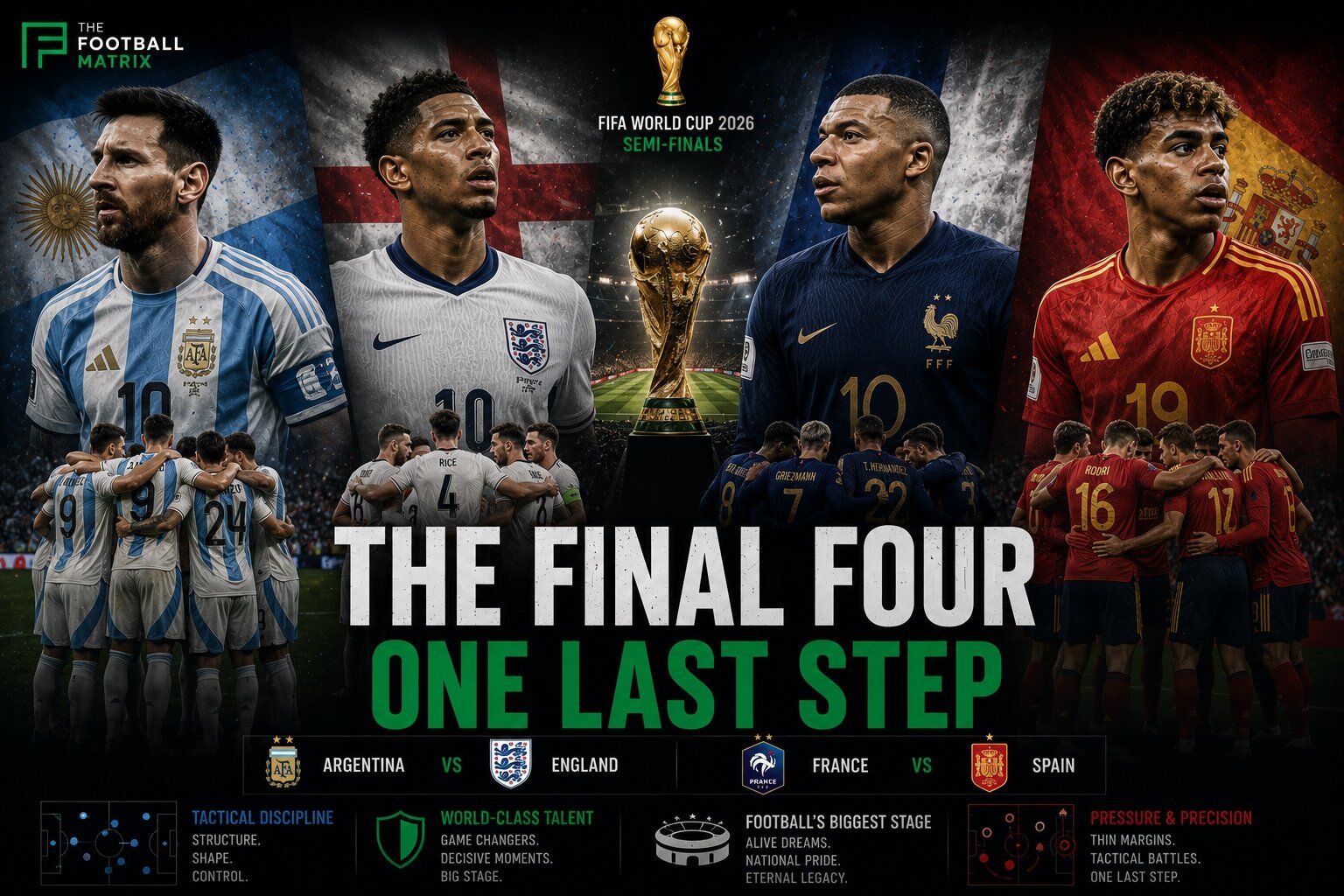
For the first time since FIFA's world rankings were introduced in 1992, the top four ranked nations have all reached the World Cup semi-finals. Argentina, Spain, France and England entered the tournament as the world's four highest-ranked teams and have all navigated vastly different routes to arrive at the same destination. There is no underdog story left in this tournament. What remains is football's highest level of tactical competition, where marginal gains, physical resilience and moments of individual brilliance are likely to decide who reaches the final.
Tournament Metric Dashboard: The Final Four
| Nation | FIFA Rank | Goals Scored | Goals Conceded | Key Player | Historical Benchmark |
|---|---|---|---|---|---|
| France | No. 1 | 16 | 2 | Kylian Mbappé (8 goals) | Third consecutive World Cup semi-final |
| Argentina | No. 2 | 17 | 6 | Lionel Messi (8 goals / 10 career World Cup assists) | Chasing consecutive World Cup titles |
| Spain | No. 3 | 11 | Lamine Yamal / Mikel Merino | Five-match clean-sheet run before Belgium | |
| England | No. 4 | 13 | Harry Kane & Jude Bellingham (6 goals each) | Back-to-back extra-time victories |
1. France vs. Spain: Europe's Tactical Heavyweights
What to Watch
Few international fixtures offer as much tactical intrigue as this one.
France have reached the semi-finals through controlled efficiency, defeating Morocco 2-0 without requiring extra time, while Spain survived a demanding 2-1 victory over Belgium after another display of their trademark positional control and defensive organisation.
The headline battle will unfold in wide areas.
Kylian Mbappé's pace behind the defensive line presents perhaps the biggest test Spain's defensive structure has faced all tournament. Luis de la Fuente's side excel at compressing central spaces and controlling possession, but containing Mbappé requires defenders capable of matching explosive acceleration in transition as well as maintaining positional discipline.
At the other end, France must find a solution for Lamine Yamal. The teenager has consistently destabilised defensive structures through direct dribbling and intelligent movement inside from the right, forcing opponents into difficult one-versus-one situations.
The midfield battle may ultimately prove decisive. Rodri's ability to dictate tempo from deep will be challenged by Manu Koné and Adrien Rabiot, whose aggressive pressing and ball-winning have formed the platform for France's defensive stability throughout the tournament. If Spain establish sustained possession through Rodri, they can dictate the rhythm. If France repeatedly disrupt that first phase, Mbappé and Ousmane Dembélé become significantly more dangerous in transition.
Player to Watch & Early Prediction
Rodri's influence could determine whether Spain control territory or spend long periods defending transitions.
France also arrive with a slight physical advantage after avoiding extra time in the quarter-finals.
Early prediction: France 1-0 Spain. A tightly contested encounter settled by one decisive transition rather than sustained attacking dominance.
2. Argentina vs. England: Experience Against Momentum
What to Watch
Where France and Spain promise a tactical contest built around structure, Argentina and England arrive carrying the physical and emotional toll of exhausting quarter-finals.
Argentina required extra time to overcome Switzerland after surrendering an early lead, while England also needed 120 minutes to eliminate Norway following another Jude Bellingham-inspired comeback. Both squads now enter the semi-finals managing fatigue as carefully as tactics.
The individual narratives naturally draw attention.
Lionel Messi continues what is expected to be his final World Cup campaign, pursuing consecutive world titles while adding another major record with his tournament-leading assist tally. England, meanwhile, have repeatedly relied on Jude Bellingham to rescue knockout matches, with the midfielder emerging as both their creative leader and biggest scoring threat.
Beyond those headlines lies an equally fascinating tactical contest.
Switzerland demonstrated that Argentina can be vulnerable when opponents attack quickly after turnovers, particularly once Scaloni's side retreat deeper to protect a lead. England possess the pace through Bukayo Saka and the midfield running power to test those same areas, provided they can sustain an aggressive press despite the accumulated fatigue of consecutive demanding knockout fixtures.
Argentina, however, remain one of international football's most experienced knockout teams. Their ability to manage momentum swings and remain composed during chaotic moments has repeatedly separated them from equally talented opponents.
Player to Watch & Early Prediction
Messi versus Bellingham will dominate the pre-match discussion, but the outcome may depend more on which midfield maintains its intensity deepest into the match.
Early prediction: Argentina 2-1 after extra time. Argentina's experience in managing high-pressure knockout matches could prove decisive if the contest extends beyond 90 minutes.
The Case for Caution
The presence of the world's top four ranked nations should not be interpreted as complete validation of FIFA's ranking system.
Rankings measure consistency across qualifying campaigns and international windows rather than performance under knockout pressure. This tournament has shown that even the favourites have displayed vulnerabilities. Argentina required extra time to overcome Switzerland, while England survived consecutive knockout matches only after late interventions from Bellingham.
Environmental conditions remain another significant variable.
The North American summer has repeatedly slowed matches during the second half, reducing pressing intensity and technical precision as fatigue accumulates. Coaches may begin with carefully constructed tactical plans, but physical endurance could become the defining factor once the matches enter their closing stages.
The Bottom Line
It is rare for the world's four highest-ranked nations to arrive together at the semi-final stage of a World Cup. Their paths have been different, but all four have demonstrated enough tactical flexibility and resilience to survive increasingly demanding knockout rounds.
France and Spain offer a contest built around positional control, midfield dominance and defensive organisation. Argentina and England promise something more volatile: two physically stretched squads led by players capable of deciding matches through moments of individual brilliance.
The tactical frameworks are already clear. What remains uncertain is which team can continue executing those ideas when fatigue, pressure and the weight of a World Cup semi-final begin to erode even the best-laid plans.
Support The Football Matrix on Google Search
Add us as a preferred source to highlight our transfer & injury intelligence in your search results.
☕ Keep The Matrix Running
The Football Matrix is independent — no ads, no paywalls, no corporate sponsors. If our coverage adds value to your matchday, consider buying us a coffee. It goes directly toward hosting, infrastructure, and keeping the editorial free for everyone.
Discussion (0)
Loading comments...