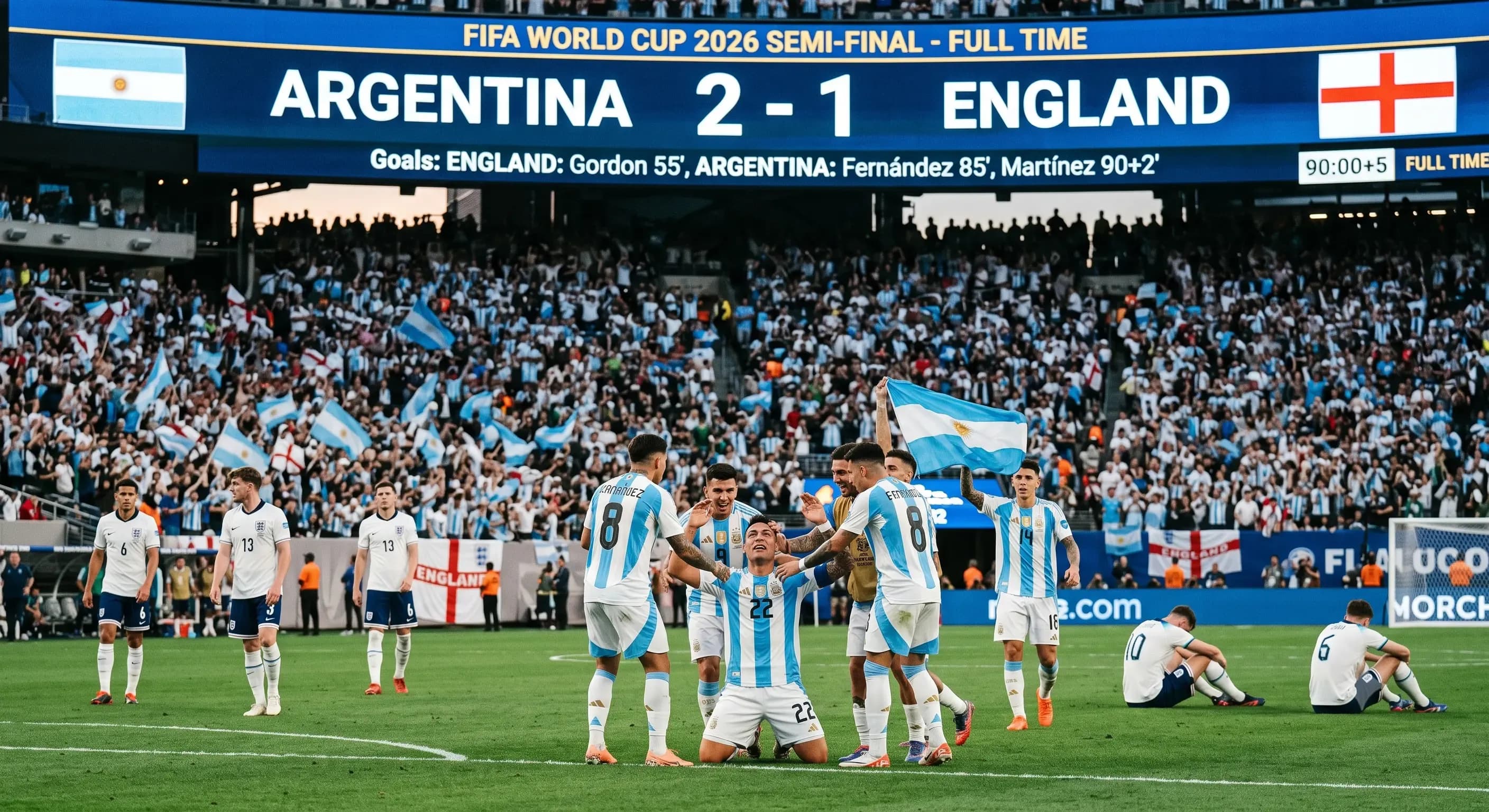
Sixty years of waiting has bred a particular kind of English hope — the sort that expects heartbreak even while dreaming of history. On Wednesday night in Atlanta, that hope collides with reality. England faces Argentina, the reigning world champions, for a place in the World Cup final, and the team that gets them there barely resembles the one English fans thought they wanted eighteen months ago.
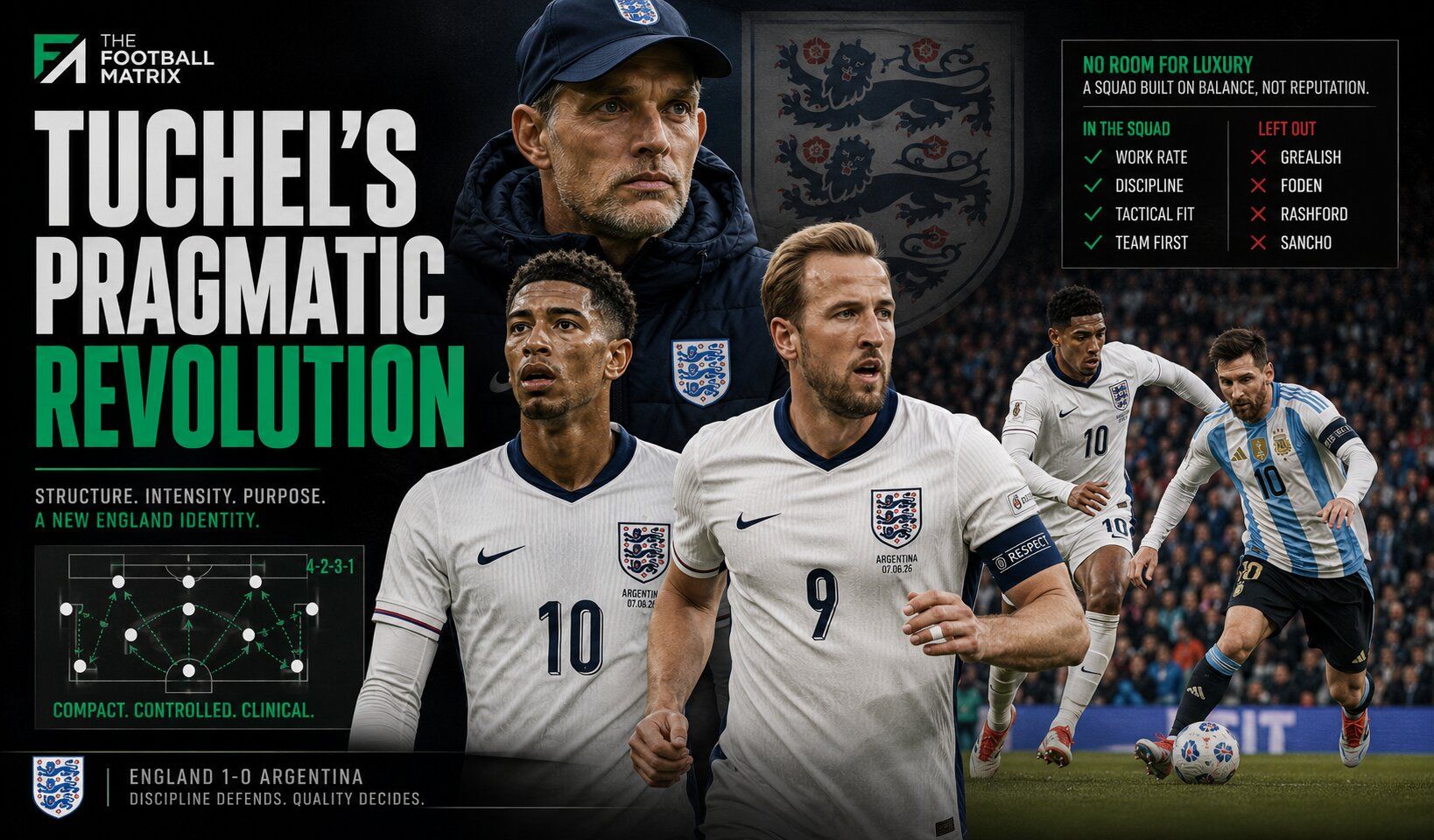
Thomas Tuchel has not built this side around individual brilliance. He has constructed it around structure, recovery runs, and positional discipline — leaving some of the country's most gifted players watching from home. Phil Foden, Cole Palmer, and Trent Alexander-Arnold are names that would have walked into most England squads of the past decade, now discarded in favor of a system that prioritizes function over flair. The result is a team winning ugly, winning late, and winning consistently. Whether that's sustainable against Lionel Messi's Argentina — and whether it can be maintained within the England dressing room — is the prevailing question heading into this semi-final.
The Omission of the "Luxury" Creators: A Statistical Necessity
Leaving Palmer, Foden, and Trent Behind
There was no press conference moment where Tuchel explained his reasoning in forensic detail, but the numbers behind his June squad announcement tell their own story. Cole Palmer and Trent Alexander-Arnold posted progressive pass completion rates of 67.7% and 67.5% respectively across the 2025/26 club season — figures that, in isolation, sound reasonable. However, in the context of tournament football, where turnovers in advanced areas can be punished by elite transition teams, they represented a risk Tuchel wasn't willing to take.
This isn't merely a story about talent. Nobody seriously argues Alexander-Arnold lacks the range of passing to unlock a defense, or that Foden can't glide past a fullback. The argument centers on what happens in the six seconds after possession is lost. Tuchel's England is built to survive those moments, not gamble on them.
The Physicality and Dueling Metrics of Anderson and Spence
Instead, look at the players who did make the squad. Djed Spence recorded 257 duels and 176 interceptions across his domestic season — numbers that highlight relentless recovery work rather than eye-catching creativity. Elliot Anderson, a Nottingham Forest midfielder few outside England's core fanbase would have named in a squad preview twelve months ago, leads the entire England squad in tackles at this World Cup with 14.
Neither of those statistics will feature in a highlights reel, but they explain why Tuchel trusts these players over more decorated alternatives. In a tournament where England have trailed DR Congo for 75 minutes and faced a long fight against Norway, the capacity to win the ball back and reset shape has mattered more than the ability to thread a final pass. Anderson and Spence may not be the players England expected to carry them to a semi-final, but they embody how it has happened.
Anatomy of the Chameleon: How England Plays Under Tuchel
The 3-4-2-2 Buildup and Wide Overload Diamonds
Watch England in possession, and the back four essentially disappears. Jordan Pickford splits between John Stones and Marc Guéhi, effectively becoming a third center-back in buildup — a structural quirk that frees Nico O'Reilly and Ezri Konsa to push into positions that resemble wingers more than full-backs. It's a shape Tuchel has utilized before at club level, and its logic is straightforward: by developing a temporary three at the back, England creates numerical parity against most opposition front lines while still pushing bodies high and wide.
In front of that back three sit Declan Rice and Anderson, operating as a disciplined double pivot. Their job isn't to dictate tempo through flashy passing — it's to receive under pressure and "bounce" the ball into space, absorbing the first wave of an opponent's press so the team can progress without panic.
The most interesting movement comes from Jude Bellingham and Harry Kane. Bellingham drifts right, Kane drops left, and together they operate almost as dual number tens rather than a conventional striker-plus-attacking-midfielder pairing. This creates rotating overloads out wide — a fullback, a pivot midfielder, a winger, and a dropping ten all occupying the same flank at different moments. Opposition midfields struggle to keep their shape while tracking the rotations, which opens central passing lanes.
Squeezing the Half-Spaces: The Out-of-Possession Mid-Block
Without the ball, the transformation is just as deliberate. England drops into a flat 4-4-2 or 4-5-1, prioritizing central compactness over an aggressive high press. This setup isn't designed to win the ball back immediately — it's meant to deny space in crucial areas, forcing opponents into low-value possession out wide.
When the press does trigger, it follows an out-to-in pattern borrowed from Tuchel's time at Bayern Munich: wingers like Anthony Gordon and Bukayo Saka angle their runs to push the ball inside rather than chase it down the touchline, funneling play into the congested center where Rice, Anderson, and Bellingham can spring the counter-press. It's a patient, almost passive-looking structure until the trap springs shut.
System vs. Star: The Tuchel-Bellingham Friction
The Restless Perfectionist vs. The Clutch Talisman
Tuchel's entire project is built on control — of shape, tempo, and risk. Bellingham's value to England arises from a contrasting instinct: the willingness to abandon structure at crucial moments, finding pockets of space nobody planned for, and producing what a system can't manufacture on its own. He scored England's equalizer in the 45th minute against Norway and the extra-time winner that sent them through. Neither goal originated from a coaching manual.
That tension isn't new in football. Many successful teams have found harmony between a structural coach and a player who occasionally operates outside the lines. What's notable here is how openly it's surfaced.
"Yeah Well, Whatever" — Analyzing the Post-Norway Spat
After the win in Miami, Tuchel didn't offer the usual tournament diplomacy. He called the performance "sloppy" and stated England had been "lucky." Bellingham's response, delivered to reporters shortly after, was pointed: "Yeah well, whatever," coupled with a suggestion that Tuchel "doesn't know what it's like to play in these conditions."
"You're not going to win every game popping the ball and making a thousand passes. Sometimes you have to win dirty." — Jude Bellingham, Post-Norway Match (QF WC 2026)
It's important to be cautious about what this exchange represents. There is no confirmed dressing-room breakdown — no reports of a training-ground fracture or a squad divided into camps. What it reveals is two legitimate football philosophies colliding in public. Tuchel wants control even in victory. Bellingham seeks acknowledgment for delivering victory without it. Whether this friction sharpens England or ultimately undermines them remains unanswered — and may not need to be, if Wednesday goes their way.
The Anti-Southgate: In-Game Chess and Tournament Street-Smarts
Surviving the Azteca: The 10-Man Defensive Shift
If there's a single passage of play that captures Tuchel's approach, it's what unfolded in Mexico City. Jarell Quansah was sent off in the 52nd minute with England already stretched thin. Rather than retreating into containment, Tuchel restructured immediately — switching to a 5-3-1, with Dan Burn anchoring the box, Spence repositioned to left wing-back to track Mexico's runners, and Anderson shifting into a wider defensive role. England won 3-2.
It's a small tactical episode, but it illustrates how this coaching staff processes chaos. There was no hesitation, no reverting to a plan that had already stopped working. There was a second plan, ready to deploy in real time.
Suffer-Ball: Why Winning Dirty is a Feature, Not a Bug
In contrast, the version of England fans grew accustomed to under Gareth Southgate featured in-game adjustments that often arrived reactively, sometimes too late, and rarely with this level of structural rethink mid-crisis. Tuchel's England has trailed DR Congo for 75 minutes, needed extra time against Norway, and survived a red card in the last 16. None of it has looked serene, but all of it has led to progression.
The counterargument deserves airtime here, as it's not without merit. England has not dominated matches in this tournament. They ground out a goalless draw against Ghana and required a late Kane brace to defeat DR Congo. If Argentina scores first and sits deep, the absence of an unstructured game-breaker in the final third — precisely the kind of player Tuchel left at home — could leave England well-organized but short of answers.
Semi-Final Preview: Can England Neutralize Messi's Argentina?
The Midfield Battle: Rice & Anderson vs. Mac Allister & Fernandez
Argentina's route to this semi-final has been built on control through midfield, with Alexis Mac Allister and Enzo Fernandez looking to dictate tempo as they have throughout the tournament. England's response will likely mirror what has worked so far: Rice and Anderson denying central space, forcing Argentina's build-up wide, and trusting their compact mid-block to reduce Messi's touches in the half-spaces to low-value ones.
Messi remains the tournament's leading scorer with eight goals, two clear of Kane and Bellingham. Nobody can completely neutralize him. The realistic aim for England is containment — limiting the number of times he receives the ball facing the goal with space to work in, rather than eliminating his influence outright.
Exploiting the High Line: Kane's Movement Against Romero
The more intriguing battle may occur at the other end. Kane's tendency to drop into the left half-space — a pattern he has refined at club level — could pull Argentina's central defenders out of position and open running lanes behind Cristian Romero's line, particularly if Argentina commits to their usual high defensive setting. Kane and Bellingham are tied as England's top scorers in this tournament with six goals each. If Argentina pushes up as they have throughout the competition, the space behind them may present England's best chance to reach a first World Cup final since 1966.
One statistic sits uncomfortably for England ahead of kickoff: Argentina has reached the final on all five previous occasions they've made a World Cup semi-final. History isn't destiny, but it carries weight.
So Will It Come Home?
Tuchel's England will never be mistaken for the free-flowing sides that generations of fans imagined lifting a World Cup. There's little romance in a team organized around defensive recovery data and progressive pass completion rates. However, romance hasn't won England a World Cup in sixty years, and pragmatism, however unglamorous, has brought this squad within one match of a final. Whatever tension exists between the manager's systems and his talisman's instincts has not hindered them from delivering when it mattered. Atlanta will decide whether that's enough and if they have what it takes to "Bring It Home".
Support The Football Matrix on Google Search
Add us as a preferred source to highlight our transfer & injury intelligence in your search results.
☕ Keep The Matrix Running
The Football Matrix is independent — no ads, no paywalls, no corporate sponsors. If our coverage adds value to your matchday, consider buying us a coffee. It goes directly toward hosting, infrastructure, and keeping the editorial free for everyone.
Discussion (0)
Loading comments...