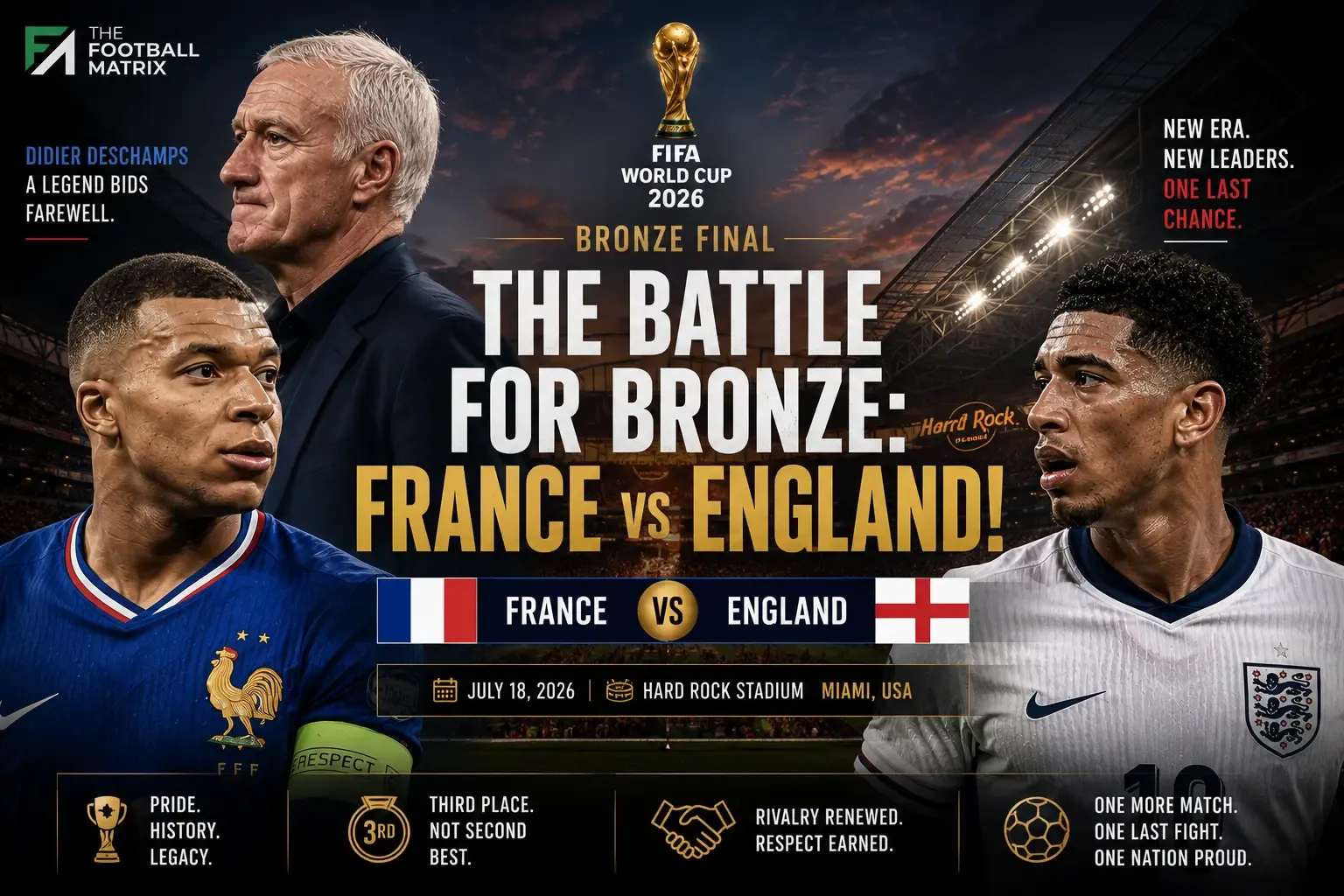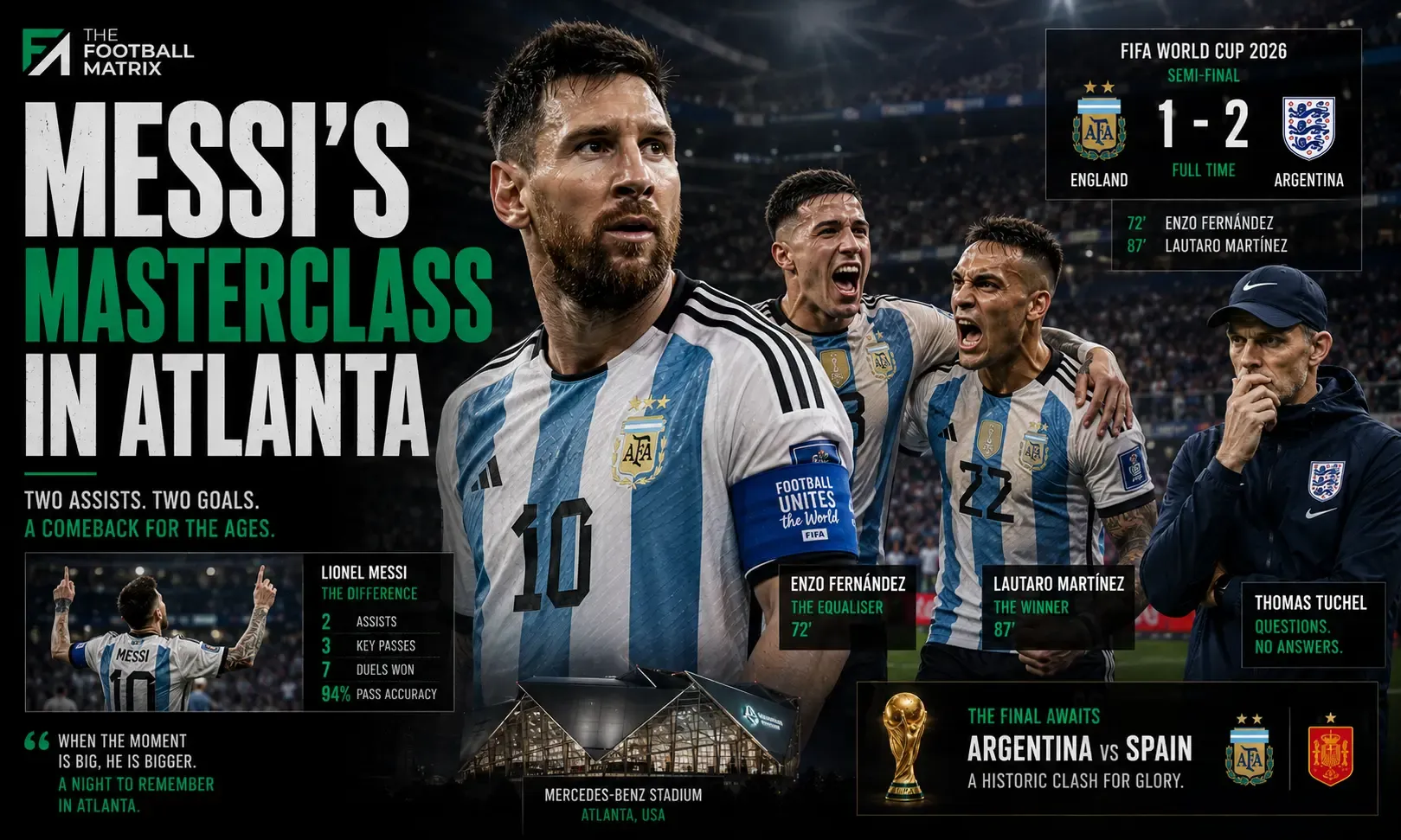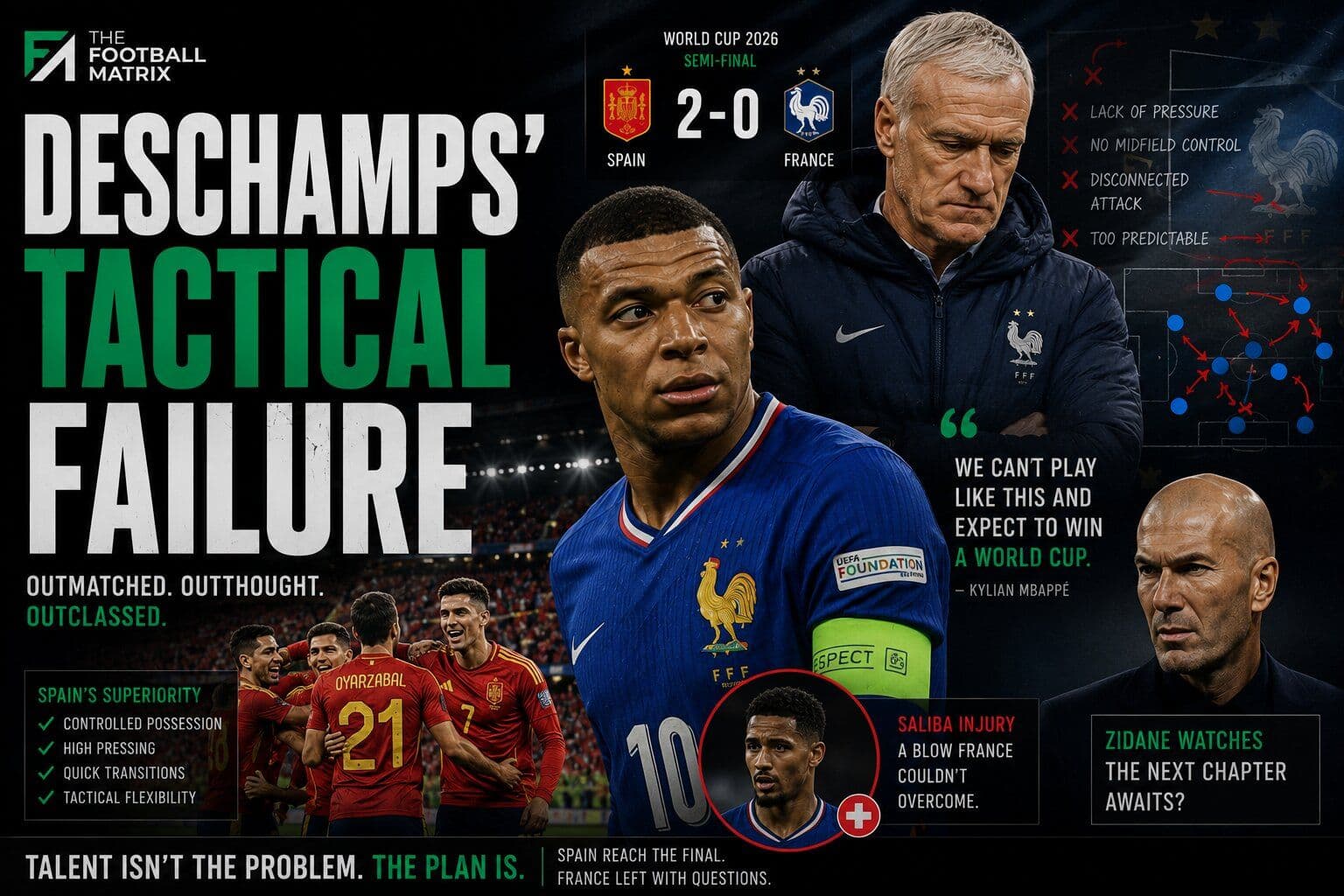
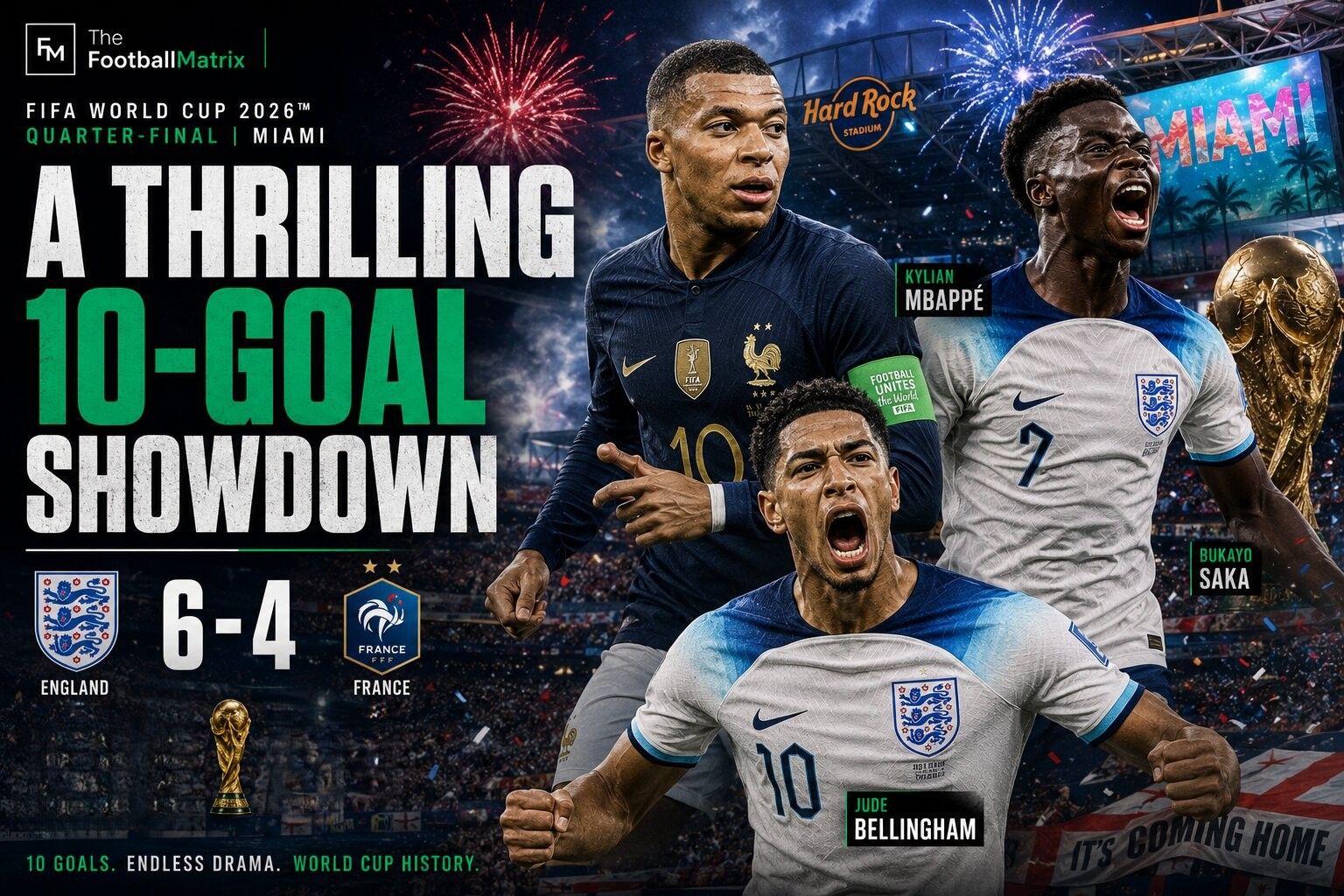
Third-place play-offs are often dismissed as inconsequential matches, overshadowed by the semi-finals and the final, typically played by players with one eye on their summer holidays. However, on July 19, at Hard Rock Stadium, Thomas Tuchel's England and Didier Deschamps' France defied expectations. What unfolded was not merely a consolation match, but a ten-goal thriller that reshaped the World Cup record book in the space of ninety-eight minutes. By full time, England had claimed a 6-4 bronze that will be remembered long after most third-place finishes have faded into obscurity.
A Rotated France Pays the Price
Deschamps made sweeping changes to a defence that had already been stretched thin through the knockout stages, and the gamble backfired spectacularly. Declan Rice exploited the space in front of a reshuffled back four with a third-minute strike from distance, then turned provider fifteen minutes later, whipping in a cross for Ezri Konsa to head home. That was merely the beginning. Bukayo Saka, restored to the side with visible sharpness, capitalized on France's growing disorganization down the left flank, scoring in the 37th minute before adding a second in stoppage time to send England into the break leading 4-0.
Embed from Getty Images Embed
The scoreline was astonishing, but the dynamics behind it were clear. Theo Hernández, thrust back into a starting role, was repeatedly isolated against Saka's movement into the half-space. With Ibrahima Konaté and Kevin Lacroix unfamiliar as a central pairing, France's structure never found stability. This match marked the first time in the tournament's 96-year history that France conceded four goals in a single half of a World Cup fixture—a statistic that reflects not only individual failures but also the repercussions of a manager's selection experiment colliding with a dynamic opponent at a critical moment.
Mbappé's Second-Half Reckoning
Whatever Deschamps said at the interval worked. France emerged with renewed intent, and Kylian Mbappé—largely a peripheral figure in the first half—became the game's dominant force. His movement into the channels stretched an England back line that suddenly had no cushion to protect. His finish in the 48th minute initiated a twenty-minute spell that threatened to turn humiliation into redemption. Bradley Barcola added a sharp finish in the 54th minute, and when Mbappé struck again in the 66th, the deficit had narrowed to a single goal. Michael Olise was pivotal to this resurgence, delivering precise passes that pulled England's back four out of its aerial comfort zone and provided France's attackers with the space to operate.
For a brief period, the 4-0 humiliation appeared on the verge of becoming one of the great World Cup collapses. England's shape loosened, while France's front three exploited gaps that hadn't existed thirty minutes earlier, with Miami's humidity seemingly working in the visitors' favour rather than against them.
The Closing Chaos
England steadied themselves through squad depth rather than tactical adjustments. A rash challenge from Malo Gusto on Djed Spence in the 87th minute awarded Saka the opportunity to complete his hat-trick from the penalty spot—only the fourth hat-trick by an Englishman in World Cup history. Ousmane Dembélé pulled one back in the sixth minute of stoppage time, setting the stage for a frantic finish, before Jude Bellingham, who had come off the bench, drove through three French defenders to seal the contest at 6-4. This goal, while it may have held little bearing on the outcome, was significant for confirming Bellingham's stature: his seventh of the tournament broke the record for most goals by an England player at a single World Cup, surpassing Gary Lineker and Harry Kane.
A Match That Rewrote the Ledger
| Metric | France | England |
|---|---|---|
| Final Score | 4 | 6 |
| Shots (on target) | 19 (9) | 19 (11) |
| Halftime Score | 0 | 4 |
| Prize Money | $27m | $29m |
Beyond the scoreline, the numbers carry historical weight. The ten combined goals make this the highest-scoring third-place match in World Cup history, eclipsing France's 6-3 win over West Germany in 1958. Mbappé's second goal took him to 22 World Cup goals, moving him past Lionel Messi into sole possession of the all-time scoring record. Olise finished his tournament with six assists, matching Pelé's 56-year-old single-tournament record from 1970.
What It Means Going Forward
For Deschamps, this was a curious way to conclude a 14-year tenure—his side outplayed for a half, then almost salvaged the unthinkable before falling just short. For Tuchel, bronze represents England's best World Cup finish away from home since 1966. He has emphasized that it should serve as a foundation rather than a peak, with the 2028 European Championship the next target for progress.
Whether this result signals genuine structural growth for England or was simply a chaotic afternoon favouring attacking intent over defensive discipline remains open to debate. What is unquestionable is that a fixture routinely dismissed as meaningless produced a match that will forever be etched in the annals of World Cup history.
Support The Football Matrix on Google Search
Add us as a preferred source to highlight our transfer & injury intelligence in your search results.
☕ Keep The Matrix Running
The Football Matrix is independent — no ads, no paywalls, no corporate sponsors. If our coverage adds value to your matchday, consider buying us a coffee. It goes directly toward hosting, infrastructure, and keeping the editorial free for everyone.
Discussion (0)
Loading comments...