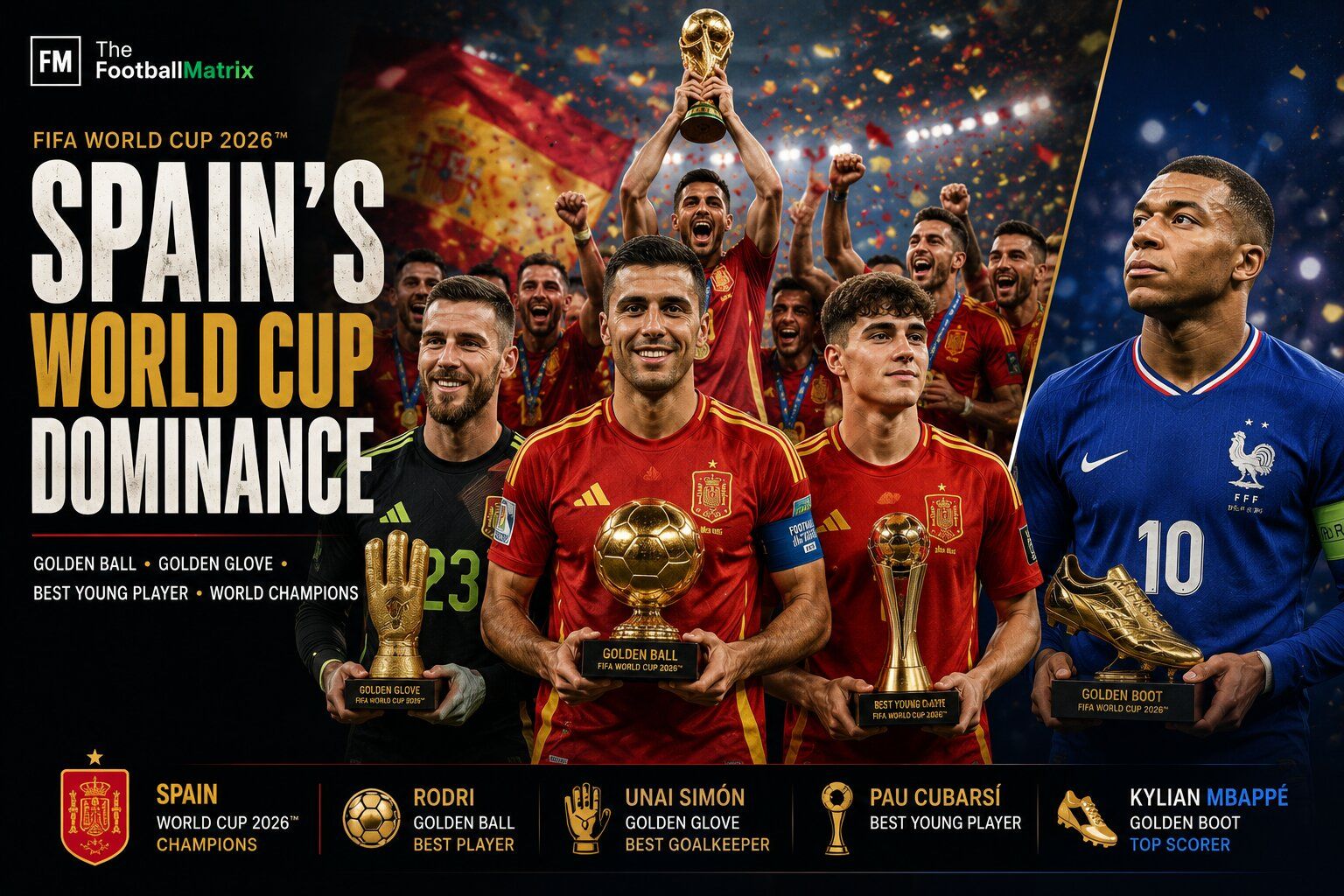
What the Awards Table Says About This World Cup
| Award | Winner (Nation) | Core Achievement |
|---|---|---|
| Golden Ball | Rodri (Spain) | Most tournament passes; 101/105 completed in the final |
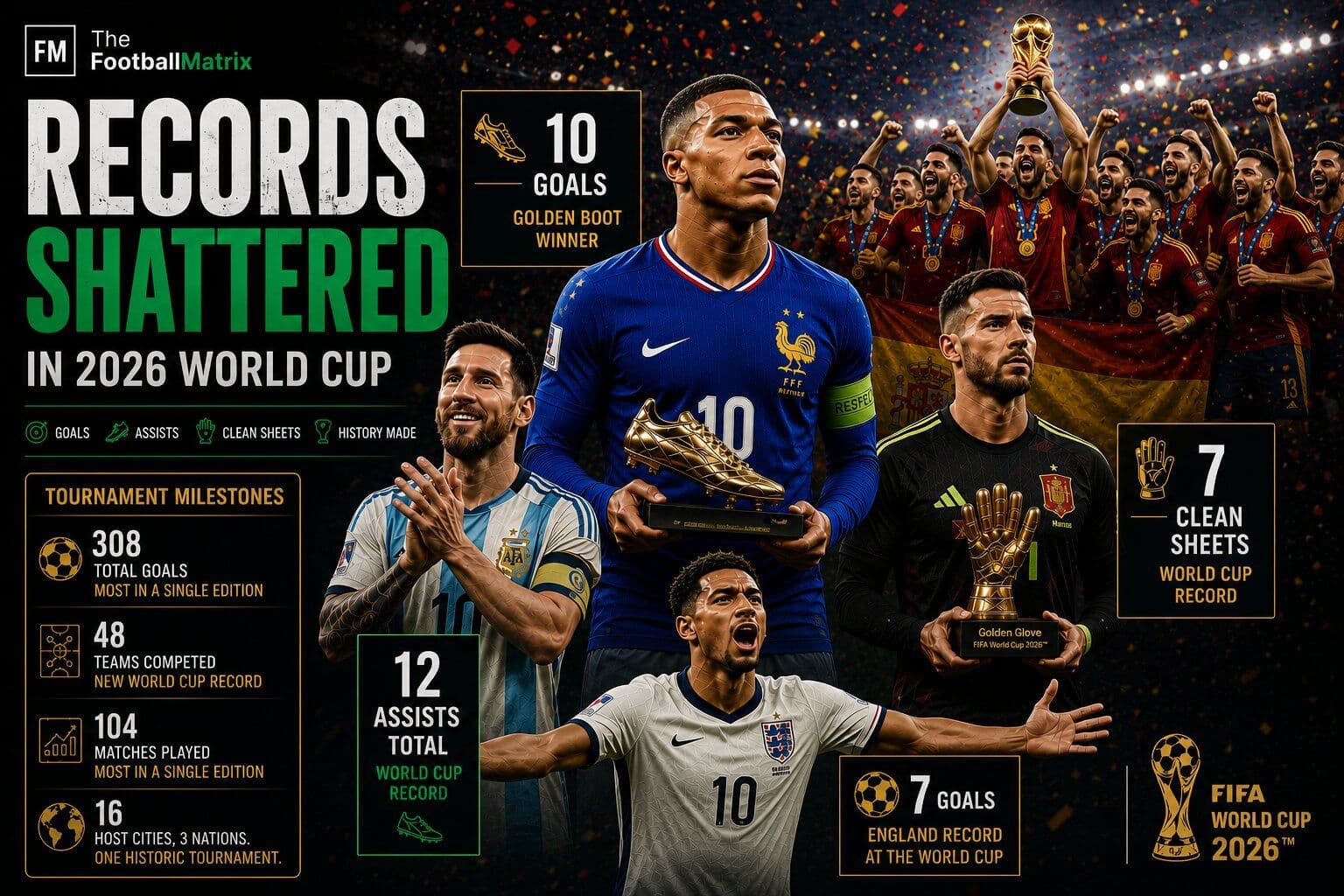
| Golden Boot | Kylian Mbappé (France) | 10 goals; back-to-back Golden Boots; 22 career WC goals |
| Golden Glove | Unai Simón (Spain) | 7 clean sheets; 650-minute shutout record |
| Best Young Player | Pau Cubarsí (Spain) | 19-year-old anchor of a defense that conceded once |
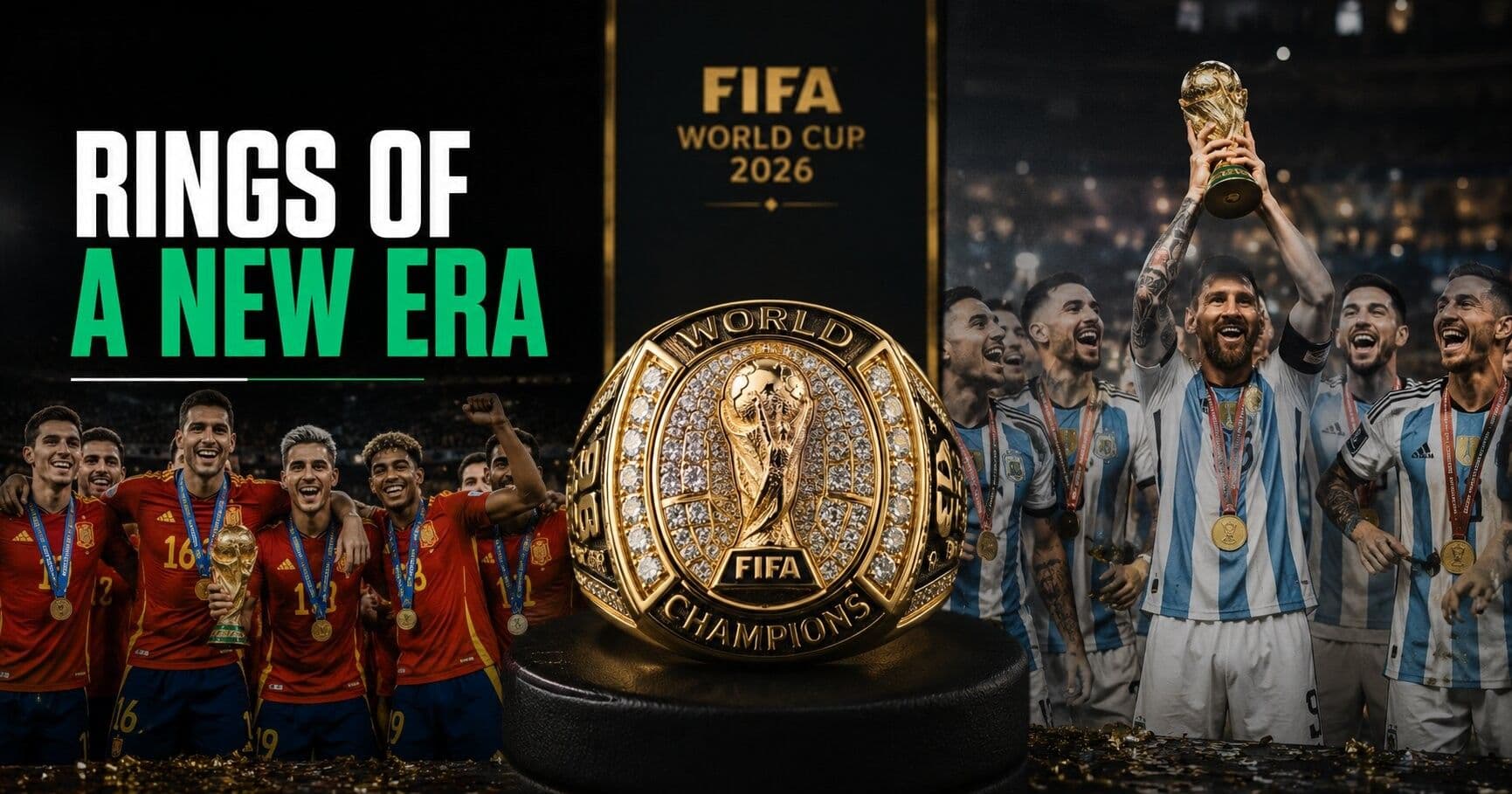
Some World Cups produce a golden generation. This one produced a golden sweep. When Spain lifted the trophy on North American soil, the tournament's individual honors mirrored that success: this Spanish side didn't merely win the competition; they defined it.
Three of the four major individual awards from the 2026 FIFA World Cup went to Spanish players, showcasing a rare alignment between collective triumph and individual recognition. The exception belonged to a Frenchman who made history in defeat. Together, the four winners illustrate what separated the contenders in North America: control in midfield, solidity at the back, and, in Kylian Mbappé's case, dominance in front of goal, regardless of his team's fortunes.
Why Rodri's Golden Ball Reflects a Different Kind of Dominance
Rodri didn't win the Golden Ball by producing the tournament's most eye-catching moment. He won it by ensuring the games rarely slipped from Spain's control in the first place. His award highlights a specific footballing value: players who manage tempo tend to have a greater impact over a month-long tournament than those who occasionally shine.
That control was evident in the final itself. Against Argentina, with the World Cup on the line, Rodri completed 101 of his 105 passes, achieving a 96% completion rate in the most pressured 90 minutes of his career. Such statistics may not always capture headlines, but they explain why Spain appeared so composed throughout the tournament. Managers value players like Rodri because they reduce variance; when your deepest midfielder misplaces so few passes, your defense faces fewer transitions, and your attackers receive the ball in more threatening positions.
While the Golden Ball has sometimes gone to the tournament's most spectacular performer, this year it recognized the most reliable one, which underscores how Spain was constructed to win the World Cup: not through chaos, but through control.
Mbappé's Golden Boot Stands Apart From the Team Story
Kylian Mbappé's tournament marks a divergence between individual and collective narratives. France didn't lift the trophy, yet Mbappé finished as the competition's leading scorer with 10 goals in eight matches, becoming the first player in the modern era to win back-to-back World Cup Golden Boots.
This consecutive achievement holds more significance than the raw goal tally. International tournaments occur every four years, and maintaining that level of finishing across two separate World Cup cycles, against defenses that have four years to study you, presents a unique challenge compared to a single explosive summer. His career World Cup goal total now stands at 22, placing him ahead of any other player in the sport's history.
Why Unai Simón's Golden Glove Was Built on More Than Shot-Stopping
Unai Simón's statistics resemble those of a goalkeeper who hardly needed to work. He achieved seven clean sheets out of eight matches, conceded only one goal throughout the tournament, and set a new World Cup record of 650 consecutive minutes without letting one in.
Such impressive numbers rarely stem from shot-stopping alone. A goalkeeper who concedes just once in eight games typically benefits from a team that defends as a cohesive unit, exactly what Spain's structure provided. Simón's award can be viewed as a Golden Glove for the entire backline, even if he is the one who receives the medal.
This is not to downplay his performance between the posts. Facing fewer shots does not guarantee clean sheets on its own — any shots faced must still be dealt with effectively, and maintaining 650 consecutive minutes without a slip demands a level of consistency that distinguishes a good tournament goalkeeper from a record-setting one.
Pau Cubarsí's Award Reveals Where Spain's Real Strength Lay
If one award best encapsulates how Spain triumphed in the tournament, it is Pau Cubarsí's Best Young Player honor. At 19, he served as the defensive anchor of a side that conceded just one goal throughout the entire competition — a defensive record that borders on historic for a modern World Cup winner.
Cubarsí's standout performance was not solely defined by his age but by how unfazed he appeared on the pitch. His spatial awareness and success rate in ground duels were crucial for a defensive unit that restricted opponents to just 10 shots on target across the tournament. For context, that figure is what some teams concede in two or three matches, not eight. A backline that disciplined does not occur by chance, and having a teenager as one of its foundational pieces speaks volumes about Spain's development pathway as well as Cubarsí's talent.
Support The Football Matrix on Google Search
Add us as a preferred source to highlight our transfer & injury intelligence in your search results.
☕ Keep The Matrix Running
The Football Matrix is independent — no ads, no paywalls, no corporate sponsors. If our coverage adds value to your matchday, consider buying us a coffee. It goes directly toward hosting, infrastructure, and keeping the editorial free for everyone.
Discussion (0)
Loading comments...